Highlights
- High-Grade Underground Continuity: Systematic channel sampling across four historical underground adits has confirmed continuous very high-grade antimony within a very shallow strata-bound Carbonate Replacement Deposit (CRD) unit, materially de-risking the geological model.
- Standout Grades up to 25.2% Sb: Channel sampling of underground exposures (true width) has returned multiple exceptional mineralised profiles, including:
- Mina Guadalupana:
- 1.3m @ 19.70% Sb
- 1.6m @ 7.17% Sb
- 1.3m @ 17.20% Sb
- 0.6m @ 13.95% Sb
- Mina San Pedro:
- 1m @ 13.85% Sb
- 1m @ 12.75% Sb
- 0.85m @ 3.38% Sb
- Mina Linda Vista:
- 1m @ 9.40% Sb
- 0.5m @ 11.35% Sb
- Mina San Rafael:
- 0.5m @ 10.65% Sb
- 0.8m @ 4.67% Sb
- 0.9m @ 4.13% Sb
- 0.9m @ 3.80% Sb
- Pit 1: San Jose CRD:
- 0.9m @ 25.20% Sb
- Mina Guadalupana:
- Defined Geological Model: High-grade antimony is consistently hosted within a highly receptive silicified limestone replacement unit directly beneath a defining stratigraphical gypsum capping layer, giving EVR a clear, repeatable target horizon (San José).
- Superior Sampling Representativity: Systematic channel sampling has yielded highly representative grade profiles in shallow, fractured ground. Unlike diamond drilling, where high-grade fines are frequently washed away as slurry, this sampling methodology captures the complete mineralised profile, materially de-risking the geological model.
- Structural Vectoring Tool Identified for Phase 2 Drilling: High-grade antimony within the CRD unit is spatially related to proximity to feeder structures, giving EVR a structural tool to vector toward the highest-grade zones in upcoming resource drilling.
- Maiden Resource Modelling Underway: Results will be integrated with historical data and ongoing Phase 1 drilling to advance towards a maiden JORC Resource at Los Lirios, targeting Q4 CY2026.
EV Resources Ltd (“EVR” or the “Company”) is pleased to present a comprehensive technical summary of underground channel sampling and structural mapping executed across historical, World War II-era mine workings at its Lirios 1 project block. The Company has confirmed high-grade antimony mineralisation across four historical underground workings, with channel sampling returning grades up to 25.2% Sb.
The results validate a continuous, structurally controlled Carbonate Replacement Deposit (CRD) system and confirm a clear vectoring tool (proximity to feeder structures) for targeting the highest grades in Phase 2 drilling. Importantly, conducting this systematic channel sampling in shallow, fractured ground provides superior sample representativity over standard diamond drilling. Preventing the loss of brittle, high-grade fine material to drilling fluids provides a highly accurate, reliable baseline to support the planned maiden JORC Mineral Resource Estimate (MRE) at Los Lirios.
EV Resources Managing Director, Mike Brown, commented: “These results give us confirmation of the relationship between feeder structures and high-grade antimony, which is consistently hosted within the CRD unit proximal to the structures. Grades up to 25.2% Sb confirm the quality of this system, and just as importantly, we have confirmed structures as a tool to vector towards higher grades within the CRD as we move to Phase 2 drilling. At a time when Western governments and defence industries are scrambling for antimony outside of China, every metre of high-grade continuity we confirm at Los Lirios strengthens our position to help solve the supply gap.”
Four Historical Workings confirm a Consistent High-Grade Antimony Horizon
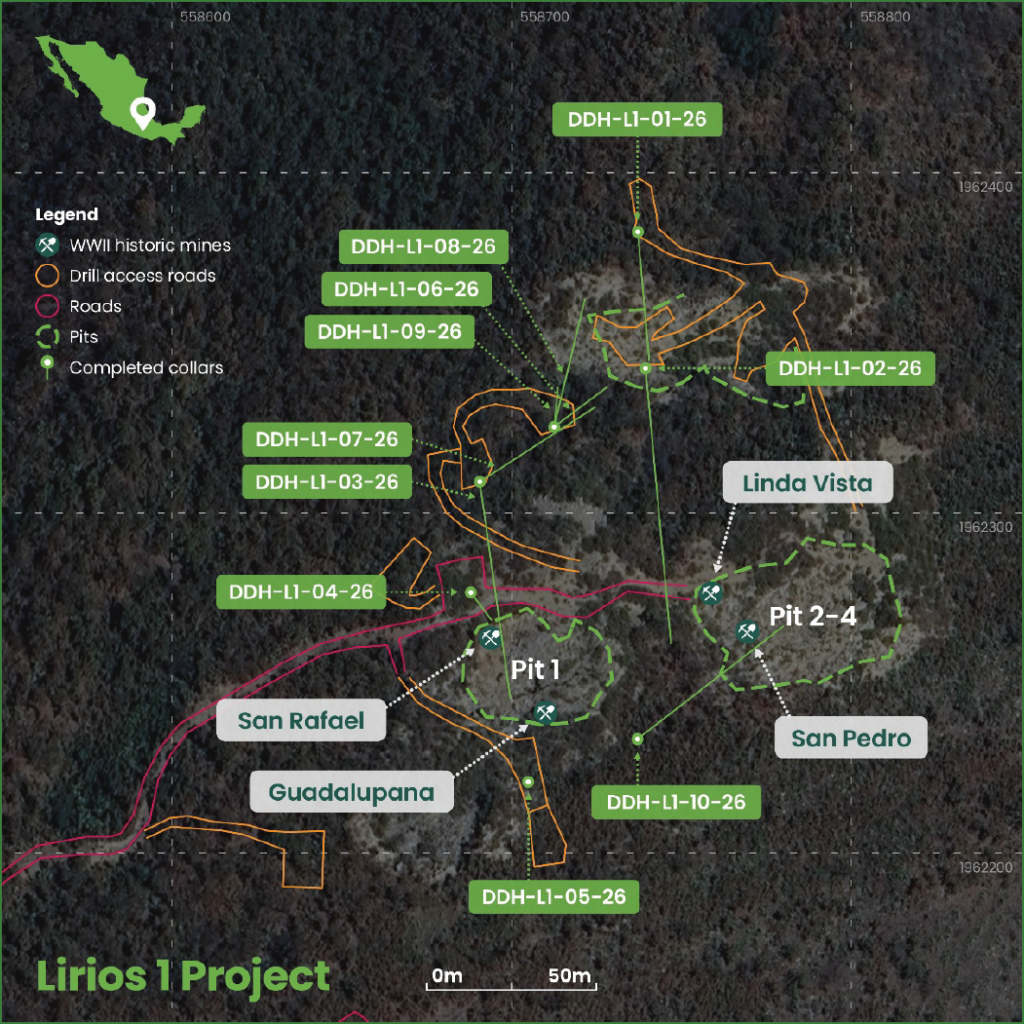
A total of 54 systematic channel samples were cut perpendicular to mineralised faces within four principal underground adit systems (San Rafael, Guadalupana, Linda Vista, and San Pedro) to evaluate the continuity, width, and grade of the target horizon. The program has successfully confirmed excellent high-grade continuity of a major strata-bound Carbonate Replacement Deposit (CRD) system (San José) that remains open for systematically planned exploration. Data will be incorporated into resource modelling as advanced.
Exposures in the historical adits, pit wall, trench face exposures and drilling have confirmed the mineralised stratigraphic column of interbedded carbonate and evaporitic (gypsum) units, with a manganese oxide rich silicified carbonate unit defined as a carbonate replacement body (CRD), hosting antimony mineralisation in the form of stibnite-quartz, with associated oxides cervantite and stibiconite depending on weathering.
The relationship of intensity of silicification and antimony mineralisation within the CRD unit where these networks pass through the CRD shows a clear fluid conduit role of these structures, with alteration and mineralisation appearing to decrease laterally away from the structures. Whilst antimony mineralisation shows localised high-grade variability within the CRD unit the channel sampling supports on a macro scale the alteration and mineralisation are consistent.
Replacement and/or infill within the overlying gypsum unit is localised to the feeder structures, with ductile deformation of the gypsum limiting mineralisation. Away from the structures, antimony mineralisation is only hosted in the CRD and observed at the lower boundary contact of the gypsum and CRD, exhibiting a cap and seal type behaviour of the gypsum with respect to the mineralising hydrothermal fluids.
- Mina Guadalupana (San José Replacement Body)
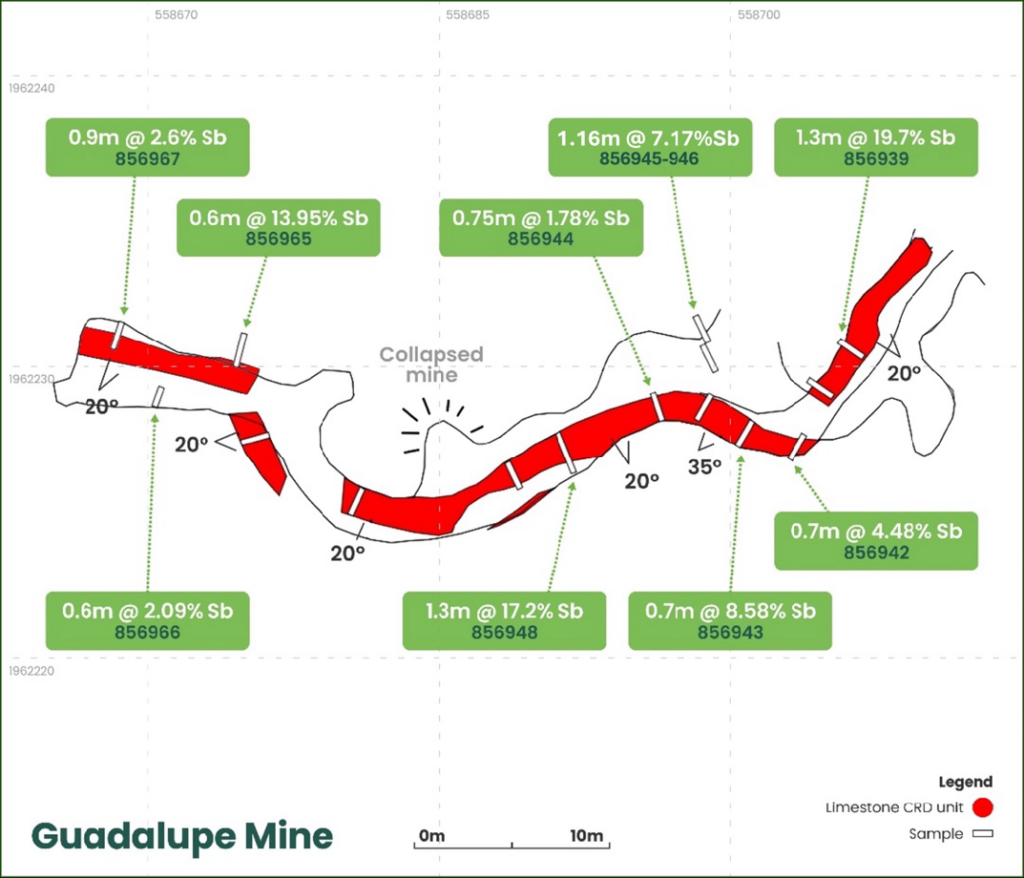
The Guadalupana mine works follow the continuous exposure of the San José replacement body over a total mapped subterranean development length of approximately 38 to 40 metres.
- Geology: Mineralisation is hosted within a heavily silicified, porous, dark grey to black limestone horizon tracking at an average dip of 10°to 20° to the southeast. The mineralised zone forms a classic replacement layout ranging from 0.95m to 2.5m in true width, containing patches of semi-massive stibnite and extensive cervantite/stibiconite oxide overprints.
Standout channel sample results include:
Table 1: Mina Guadalupana Select Significant Antimony Results
| Sample_ID | Coordinate X | Coordinate Y | Thickness (m) | Final Sb % | Sb_ICP61 | Sb_XRF15c |
| 856939 | 558,703.7 | 1,962,231.1 | 1.3 | 19.70 | 10000 | 19.7 |
| 856940 | 558,702.5 | 1,962,229.6 | 1.4 | 1.64 | 10000 | 1.64 |
| 856942 | 558,702.2 | 1,962,226.8 | 0.7 | 4.48 | 10000 | 4.48 |
| 856943 | 558,700.3 | 1,962,227.3 | 0.7 | 8.59 | 10000 | 8.59 |
| 856944 | 558,698.9 | 1,962,228.3 | 0.75 | 1.78 | 10000 | 1.78 |
| 856945 | 558,698.8 | 1,962,231.7 | 0.7 | 16.10 | 10000 | 16.1 |
| 856948 | 558,694.1 | 1,962,227.7 | 1.3 | 17.20 | 10000 | 17.2 |
| 856965 | 558,683.2 | 1,962,231.0 | 0.6 | 13.95 | 10000 | 13.95 |
| 856966 | 558,680.0 | 1,962,228.6 | 0.6 | 2.09 | 10000 | 2.09 |
| 856967 | 558,679.0 | 1,962,231.4 | 0.9 | 2.60 | 10000 | 2.6 |
2. Mina San Pedro
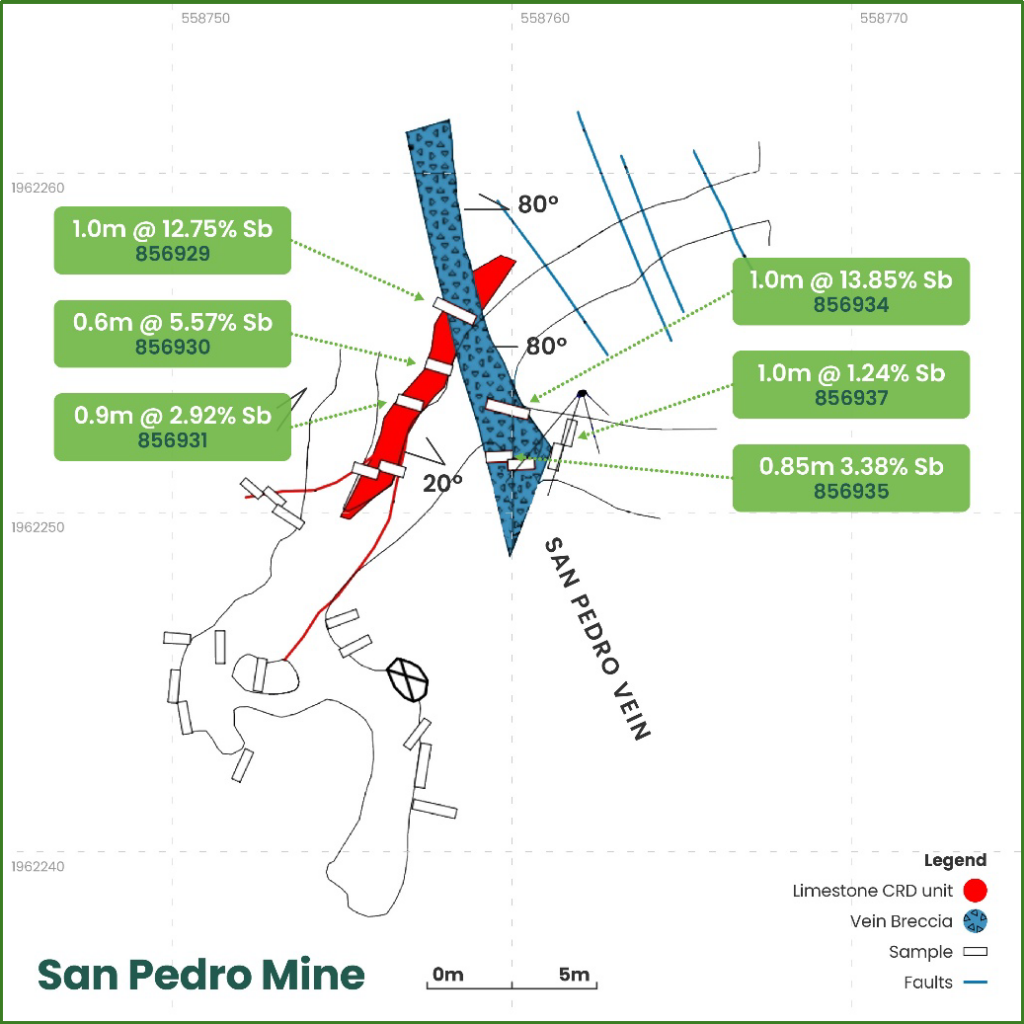
Located in the southwestern sector of the property, the San Pedro adit tracks a 32-metre underground development footprint mapping out the structural convergence of a vertical fault vein and the flat-lying CRD blanket.
- Geology: The core of the underground workings exposes a structurally controlled strata-bound replacement body demonstrating moderate to strong silicification directly under a clean contact with an upper gypsum cap rock.
Standout channel sample results include:
Table 2: Mina San Pedro Select Significant Antimony Results
| Sample_ID | Coordinate X | Coordinate Y | Thickness (m) | Final Sb % | Sb_ICP61 | Sb_XRF15c |
| 856929 | 558,757.8 | 1,962,256.1 | 1 | 12.75 | 10000 | 12.75 |
| 856930 | 558,757.2 | 1,962,254.4 | 0.6 | 5.57 | 10000 | 5.57 |
| 856931 | 558,756.4 | 1,962,253.3 | 0.9 | 2.92 | 10000 | 2.92 |
| 856933 | 558,756.0 | 1,962,251.1 | 0.6 | 1.22 | 7890 | 1.22 |
| 856934 | 558,759.5 | 1,962,253.1 | 1 | 13.85 | 10000 | 13.85 |
| 856935 | 558,759.2 | 1,962,251.7 | 0.85 | 3.38 | 10000 | 3.38 |
| 856937 | 558,761.6 | 1,962,252.6 | 0.2 | 1.64 | 8250 | 1.64 |
| 856938 | 558,761.4 | 1,962,251.9 | 0.8 | 1.14 | 7150 | 1.14 |
- Mina Linda Vista
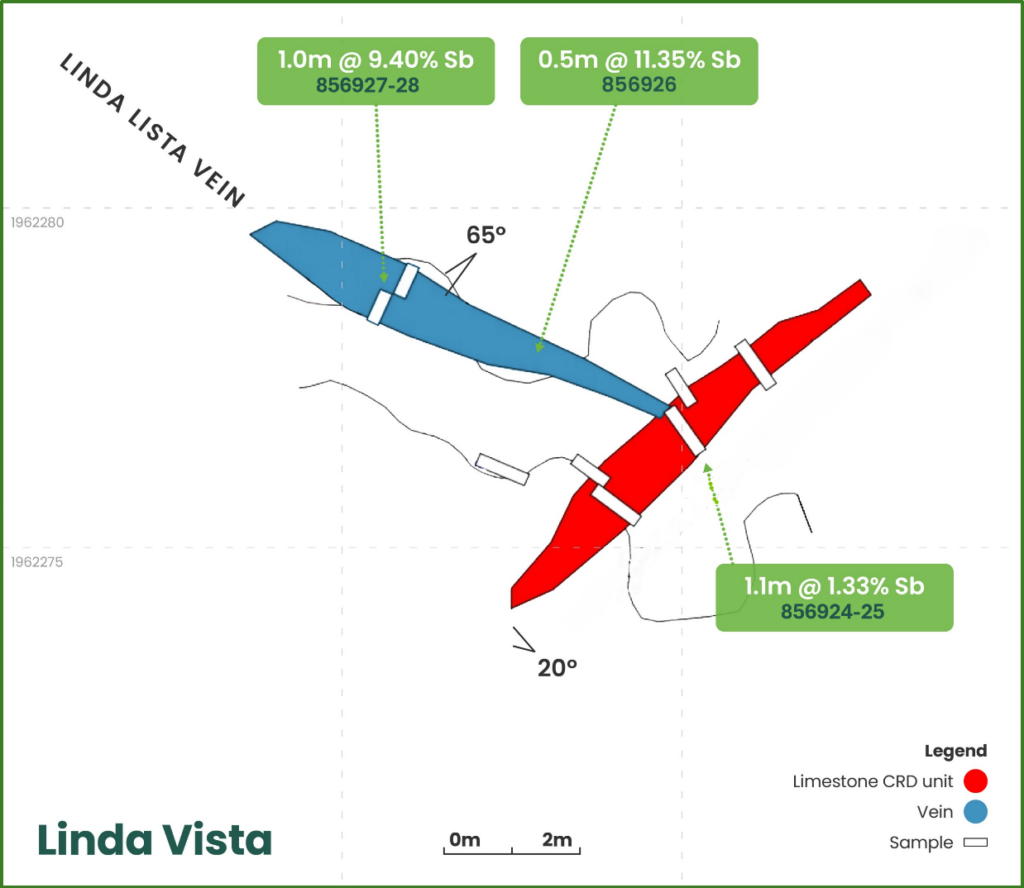
Linda Vista comprises a 12-metre accessible underground drive testing the northern margins of the system.
- Geology: Mapping clearly highlights a high-grade mineral chemical trap developed directly along the primary lithological contact interface between an upper impermeable gypsum unit and lower reactive, organic-rich black limestones.
- Significant antimony results returned from the Linda vein structure, represent the highest grades to date from feeder structures: 1m @ 9.40% Sb and 0.5m @ 11.35% Sb.
Standout channel sample results include:
Table 3: Mina Linda Vista Select Significant Antimony Results
| Sample_ID | Coordinate X | Coordinate Y | Thickness (m) | Final Sb % | Sb_ICP61 | Sb_XRF15c |
| 856924 | 558,755.0 | 1,962,277.3 | 0.3 | 4.74 | 10000 | 4.74 |
| 856926 | 558,753.6 | 1,962,277.7 | 0.5 | 11.35 | 10000 | 11.35 |
| 856927 | 558,751.1 | 1,962,279.1 | 0.5 | 4.45 | 10000 | 4.45 |
| 856928 | 558,750.9 | 1,962,278.6 | 0.5 | 14.35 | 10000 | 14.35 |
4. Mina San Rafael
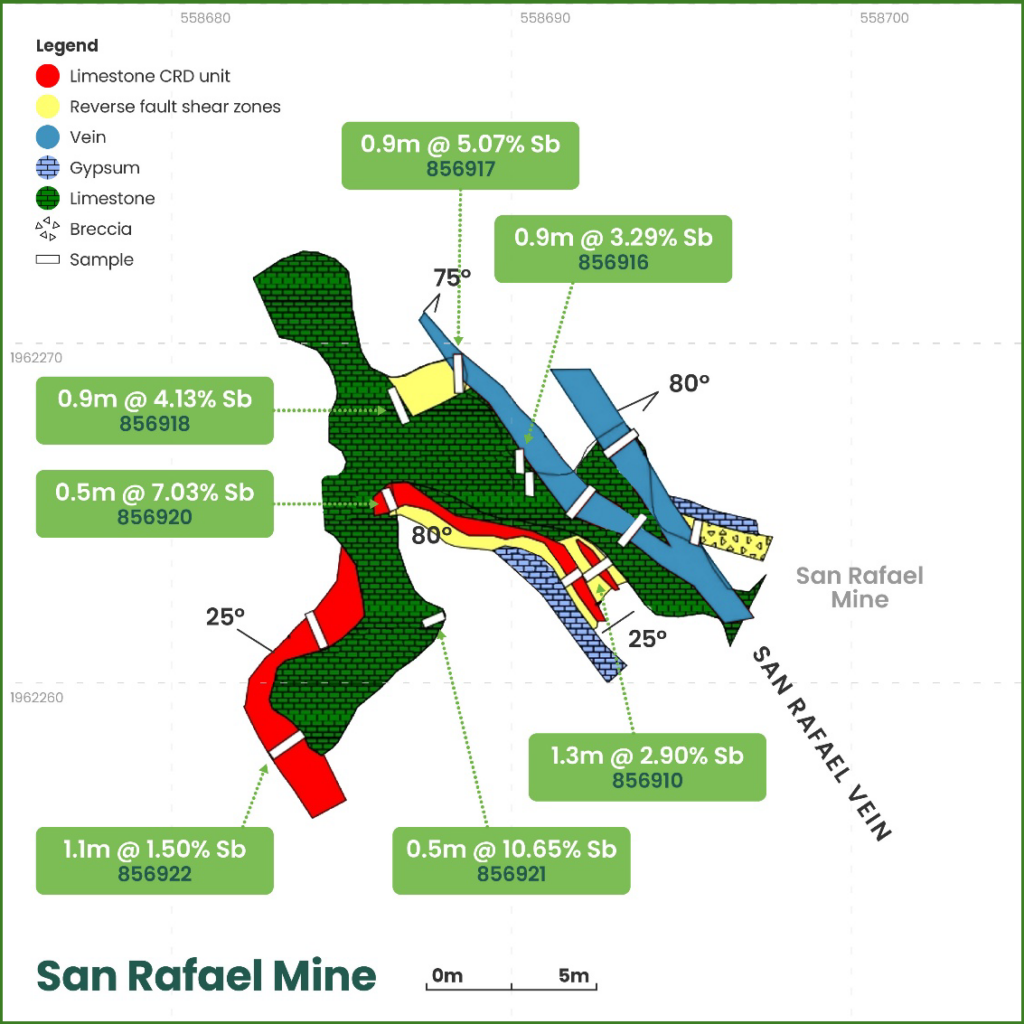
San Rafael exposes a distinct architectural mix of structural fault-veining and stratiform replacement. Presence of mineralised reverse fault structures, sample 856918: 0.9m @4.13% Sb, with adjacent mineralisation in the CRD indicates these also acted as feeder structures for mineralising hydrothermal fluids. They are also observed in pit walls at Pit 1 and Pit 5.
Table 4: Mina San Rafael Select Significant Antimony Results
| Sample_ID | Coordinate X | Coordinate Y | Thickness (m) | Final Sb % | Sb_ICP61 | Sb_XRF15c |
| 856911 | 558,692.0 | 1,962,263.3 | 0.9 | 3.80 | 10000 | 3.8 |
| 856916 | 558,690.5 | 1,962,266.3 | 0.55 | 5.07 | 10000 | 5.07 |
| 856917 | 558,688.5 | 1,962,269.6 | 0.9 | 4.13 | 10000 | 4.13 |
| 856918 | 558,686.5 | 1,962,268.7 | 0.8 | 4.67 | 10000 | 4.67 |
| 856919 | 558,686.2 | 1,962,265.9 | 0.5 | 7.03 | 10000 | 7.03 |
| 856921 | 558,687.9 | 1,962,262.0 | 0.5 | 10.65 | 10000 | 10.65 |
Stibnite Mineralisation Confirmed Consistently Across the System
The technical data from Lirios 1 confirms a robust Carbonate Replacement Deposit (CRD) configuration. Where protected from intense surface oxidation, the primary mineralised rock displays a characteristic dark grey to midnight-black coloration, driven by intense pervasive silicification tightly associated with fine-grained manganese oxides.
Antimony occurs predominantly as primary crystalline stibnite, alongside its widespread weathering-product secondary oxides, cervantite and stibiconite. These minerals occur as distinct matrix replacements, dense breccia clast coatings, and network micro-fracture fillings. No other base metal or iron sulphides were visible within the mineralised sequence.
The quality of these samples in terms of recovery is considered as good, if not better than, diamond drilling based on the sampling procedure adopted for channel sampling and the broken, weathered nature of the units in the near surface environment. Diamond drilling utilises water causing potential recovery issues which can be avoided by hand sampling.
Next Steps: Phase 2 Drilling to Test the Vectoring Structures
The successful validation of high-grade antimony within these old operational headings gives the company firm geological data points to scale up exploration:
- Surface Diamond Drilling (Phase 2): Phase 2 planning is well advanced, with a second portable rig planned to provide fast access to undertake shallow holes. This will reduce the need to construct costly and destructive access roads. Principal resource definition will target the CRD unit to the east, southeast and south at Lirios 1, the Cofradia high-grade structures and the Lirios 2 CRD extents.
- Structural Mapping: Advancing surface mapping of structures for vectoring to potential high-grade zones within the CRD unit.
- Resource Estimation Modelling: Integrating the 54 underground channels with historical data grids to establish a rigorous spatial model for target classification and maiden resource generation.
–Ends –
For further information, please contact:
Mike Brown
Managing Director & CEO
EV Resources Limited
Compliance Statement
This announcement contains exploration results from the Los Lirios Project extracted from ASX market announcement dated 12 May 2026 and reported in accordance with the 2012 edition of the “Australasian Code for Reporting of Exploration Results, Mineral Resources and Ore Reserves” (“2012 JORC Code”). The competent person for the announcements was Mr Mike Brown. EVR confirms that it is not aware of any new information or data that materially affects the information included in the original ASX market announcement. The Company confirms that the form and context in which the Competent Person’s findings are presented have not been materially modified from the original market announcement.
Competent Person Statement
Information in this announcement that relates to the collection and reporting of Exploration Results is based on information compiled by Mr Mike Brown, a Competent Person who is a member of the Australian Institute of Geoscientists. Mr Brown is the Managing Director and CEO of EVR. Mr Brown has sufficient experience relevant to the style of mineralisation, and the activity undertaken to qualify as a Competent Person, as defined by the Australasian Code for Reporting of Exploration Results, Mineral Resources and Ore Reserves (The JORC Code) 2012 Edition. Mr Brown consents to the inclusion in this announcement of the matters based on the exploration results in the form and context in which they appear.
Forward Looking Statement
Forward Looking Statements regarding EVR´s plans with respect to its mineral properties and programs are statements that are not historical facts. Words such as “expect(s)”, “feel(s)”, “believe(s)”, “will”, “may”, “anticipate(s)”, “potential(s)”and similar expressions are intended to identify forward-looking statements. These statements include, but are not limited to statements regarding future production, resources or reserves and exploration results. All of such statements are subject to certain risks and uncertainties, many of which are difficult to predict and generally beyond the control of the company, that could cause actual results to differ materially from those expressed in, or implied or projected by, the forward-looking information and statements. There can be no assurance that EVR’s plans for development of its mineral properties will proceed as currently expected. There can also be no assurance that EVR will be able to confirm the presence of additional mineral resources, that any mineralisation will prove to be economic or that a mine will successfully be developed on any of EVR’s mineral properties. The performance of EVR may be influenced by a number of factors which are outside the control of the Company and its Directors, staff, and contractors.
These risks and uncertainties include, but are not limited to: (i) those relating to the interpretation of drill results, the geology, grade and continuity of mineral deposits and conclusions of economic evaluations,
(ii) risks relating to possible variations in reserves, grade, planned mining dilution and ore loss, or recovery rates and changes in project parameters as plans continue to be refined, (iii) the potential for delays in exploration or development activities or the completion of feasibility studies, (iv) risks related to commodity price and foreign exchange rate fluctuations, (v) risks related to failure to obtain adequate financing on a timely basis and on acceptable terms or delays in obtaining governmental approvals or in the completion of development or construction activities, and (vi) other risks and uncertainties related to the company’s prospects, properties and business strategy. Our audience is cautioned not to place undue reliance on these forrward-looking statements that speakonly as of the date hereof, and we donot undertake any obligation to revise and disseminate forward-looking statements to reflect events or circumstances after the date hereof, or to reflect the occurrence of or non-occurrence of any events.
About EV Resources
EV Resources (ASX: EVR) is a critical minerals exploration and development company focused on securing the North American antimony supply chain.
We are rapidly transitioning from a diversified explorer to an expected near-term antimony producer. Antimony is a designated critical mineral by the US, EU, and Australia, with applications in energy storage, battery technology, defence, and high-tech applications.
Our asset portfolio is strategically positioned in mining-friendly jurisdictions:
- Tecomatlán Processing Plant, (Mexico). Targeting a near term low CAPEX path to becoming an antimony producer. Refurbishment and installing a gravitational concentrator circuit is underway, providing a low cost highly efficient processing path for antimony, initially processing 3rd party sourced ore and eventually Los Lirios material.
- Los Lirios Antimony Project (Mexico): Our flagship, high-grade antimony project, 50km from the Tecomatlán plant. First-pass drilling has confirmed a laterally extensive CRD system, with advancement towards a maiden JORC Resource delineation underway.
- US Antimony Projects – Dollar and Milton (Nevada): 100%-owned assets strategically positioned to support the US domestic critical minerals supply chain, aligned with US government antimony designation priorities.
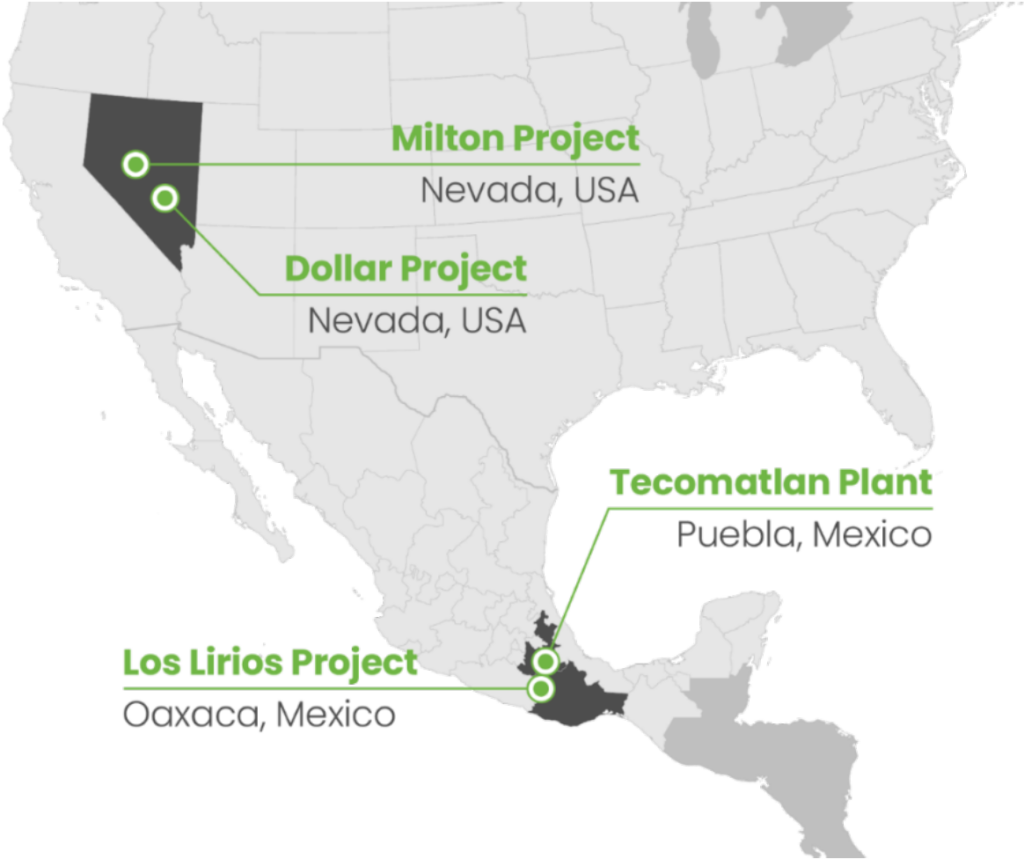
Source: EV Resources Ltd.
Original Press Release: https://api.investi.com.au/api/announcements/evr/80e70e2f-0fc.pdf