Geophysics further supports the Company’s model that Cruz de Plata is a large-scale, rich, intact mineralized system
Vancouver, British Columbia–(Newsfile Corp. – May 8, 2026) – Capitan Silver Corp. (TSXV: CAPT) (OTCQX: CAPTF) (“Capitan” or “the Company”) is pleased to report that it has received the final interpretative products and reports from its property-wide Airborne Magnetotelluric (“MT”) geophysical survey at its 100% owned Cruz de Plata silver-gold project, located in Durango, Mexico. The Airborne MT survey, completed by Expert Geophysics Limited, represents the first property-scale geophysics program completed at the property.
Highlights:
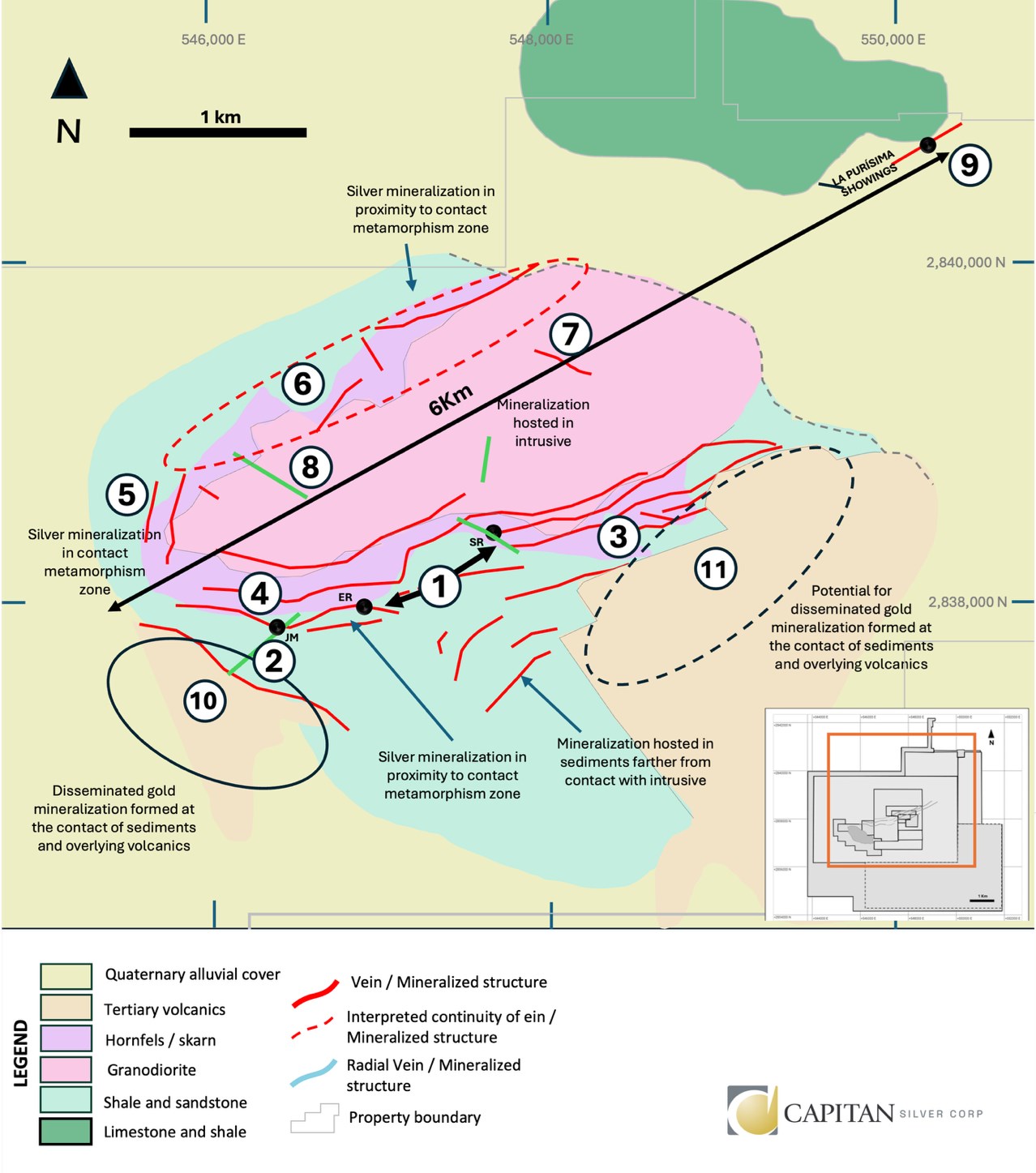
- Data from Airborne geophysics further supports the Company’s geological model, that Cruz de Plata is a significant large-scale, silver-rich mineral system (see Figures 2/2A/2B) and Capitan news release dated October 1, 2025):
- On-strike extension of the Jesus Maria Silver Trend target confirmed around the large granodiorite intrusive to the west and north (representing a mirror image of the Jesus Maria Silver Trend to the north (see Figure 2/2B)
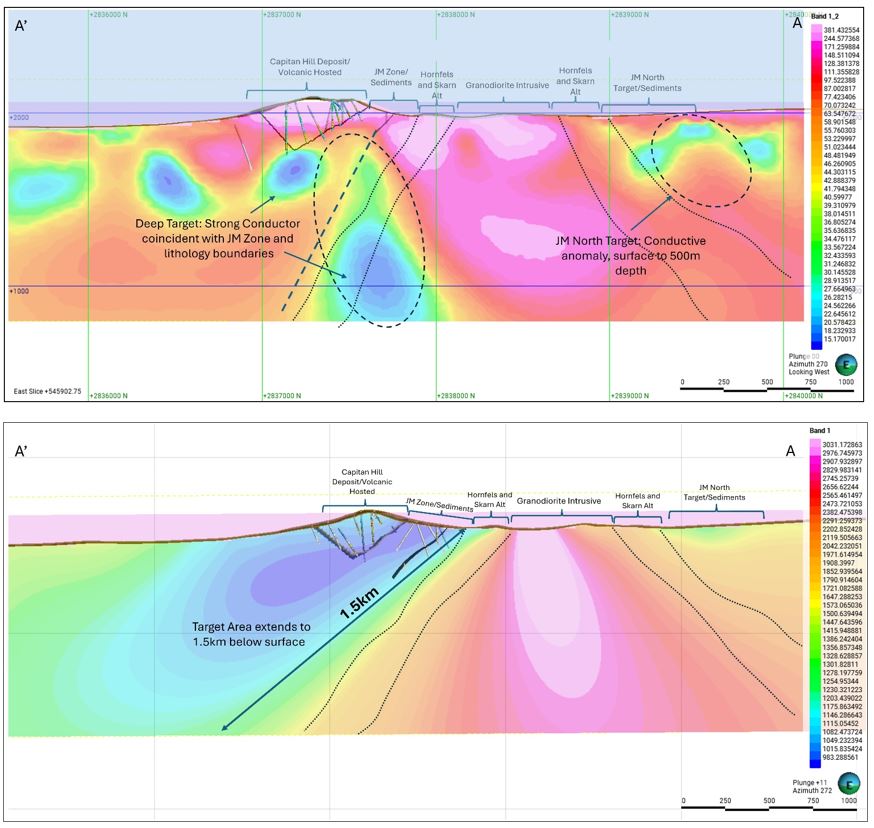
- Strong vertical continuity of major geological features in geophysics with projections deeper than 1.5 km down-dip from surface; consistent with Intermediate Sulphidation Epithermal Systems (see Figure 4)
- Multiple new targets identified at Cruz de Plata, both along strike and at depth (see Figures 3/3A and 4)
- Catalysts: Assays pending for 64 drill holes: 35 reverse circulation (RC) holes and 29 core holes)
Alberto Orozco, CEO of Capitan Silver, commented:
“The results of the first property-wide geophysical survey at Cruz de Plata reinforces our confidence in the prospectivity, richness, and large-scale potential of the Cruz de Plata project. Magnetic data has shown a strong correlation with our current geological understanding of the property and previously identified mineralization. These results yield the potential for several exciting new drill targets throughout the property, where geophysical responses indicate that there could be repetition of similar mineralized structures.
“This survey also indicates the potential for significant scale at depth, where we are seeing good vertical continuity of modelled geological structures with clear boundaries extending at depths of over 1.5 km from surface down-dip, which we are following up on this year.”
Discussion
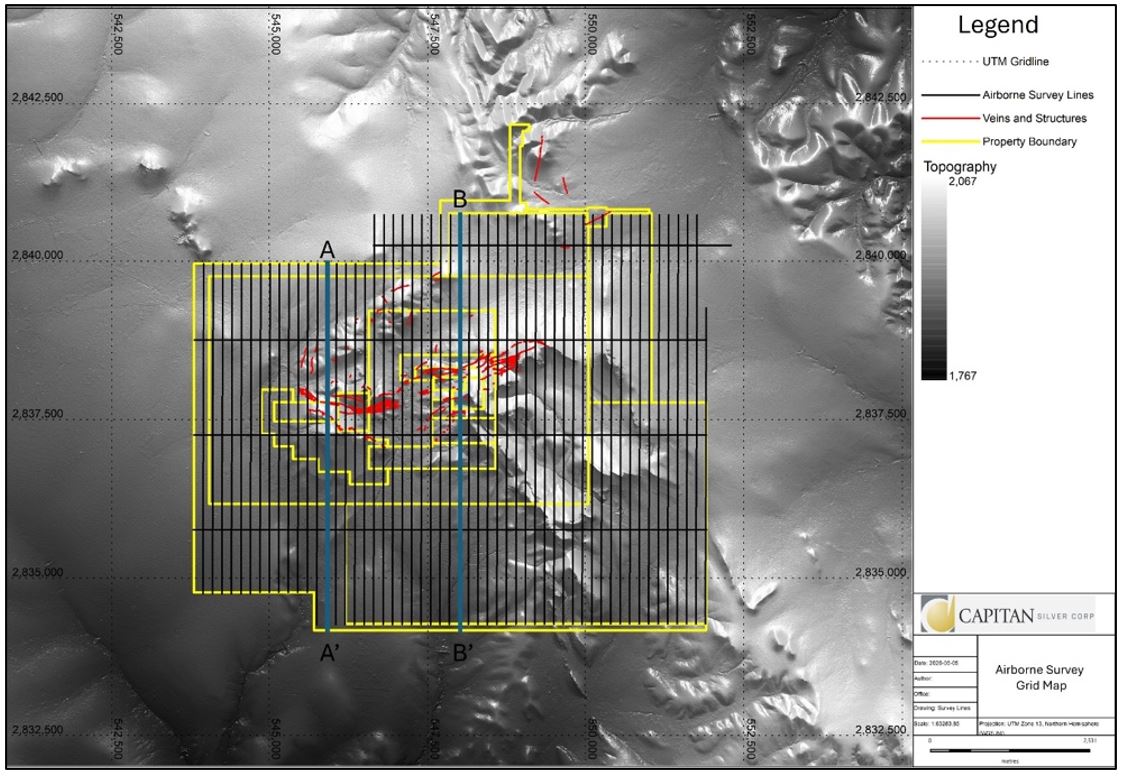
Capitan Silver engaged Expert Geophysics Limited of Newmarket, Ontario to complete a Helicopter-borne MobileMT Electromagnetic and Magnetic survey over the entire Cruz de Plata property package. Figure 1 shows the extent of the program and lines flown over Capitan’s Cruz de Plata property package.
The survey collected three datasets: MobileMT (identifies conductive and resistive zones), Total Magnetic Intensity (contrasts in lithologies and alterations), and to build a three-dimensional resistivity model of the subsurface (Conductive zones indicate fault-controlled alteration, brecciation, and sulphide mineralization. Resistive zones indicate silicification and unaltered intrusive rocks) and VLF (used to map near-surface conductive structures). Initial data evaluation involved layering these new products with Capitan’s existing database, including known mineralized zones, surface sampling, drill information, and geological interpretations to evaluate any readily discernable correlations between data sets.
To view an enhanced version of this graphic, please visit:
https://images.newsfilecorp.com/files/7373/296626_cpfig1.jpg
Cruz de Plata Mineral System Model and MT Survey
On October 1, 2025, Capitan Silver presented its current mineralization and drill targets for the Cruz de Plata project after announcing the consolidation of the property on August 22, 2025. The model showed surface mapping, sampling and limited geophysical data supporting the continuity of high-grade silver mineralization around a large body of granodiorite. The current MT geophysical survey is the first to cover the entire consolidated property and to explore it at depth.
Results from the MT survey show both the Magnetic and Resistivity Inversion models have a very strong correlation with current geological interpretations and known mineralization, reflecting major lithological boundaries and structures. Both 2D and 3D Inversion models indicate good horizontal continuity of modelled geological structures and lithology and also correlate well with known mineralized zone boundaries.
Newly Acquired Conductivity Data
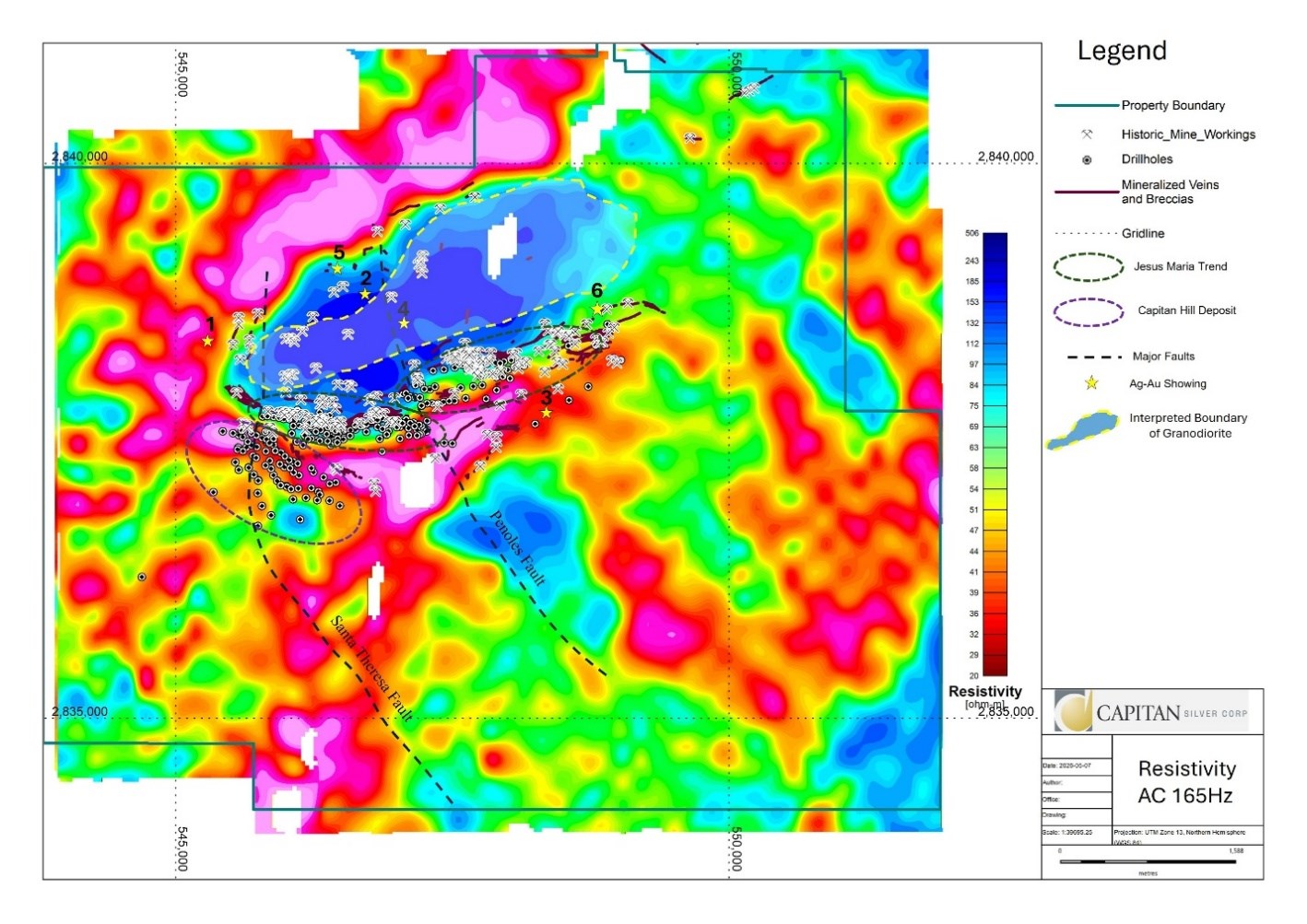
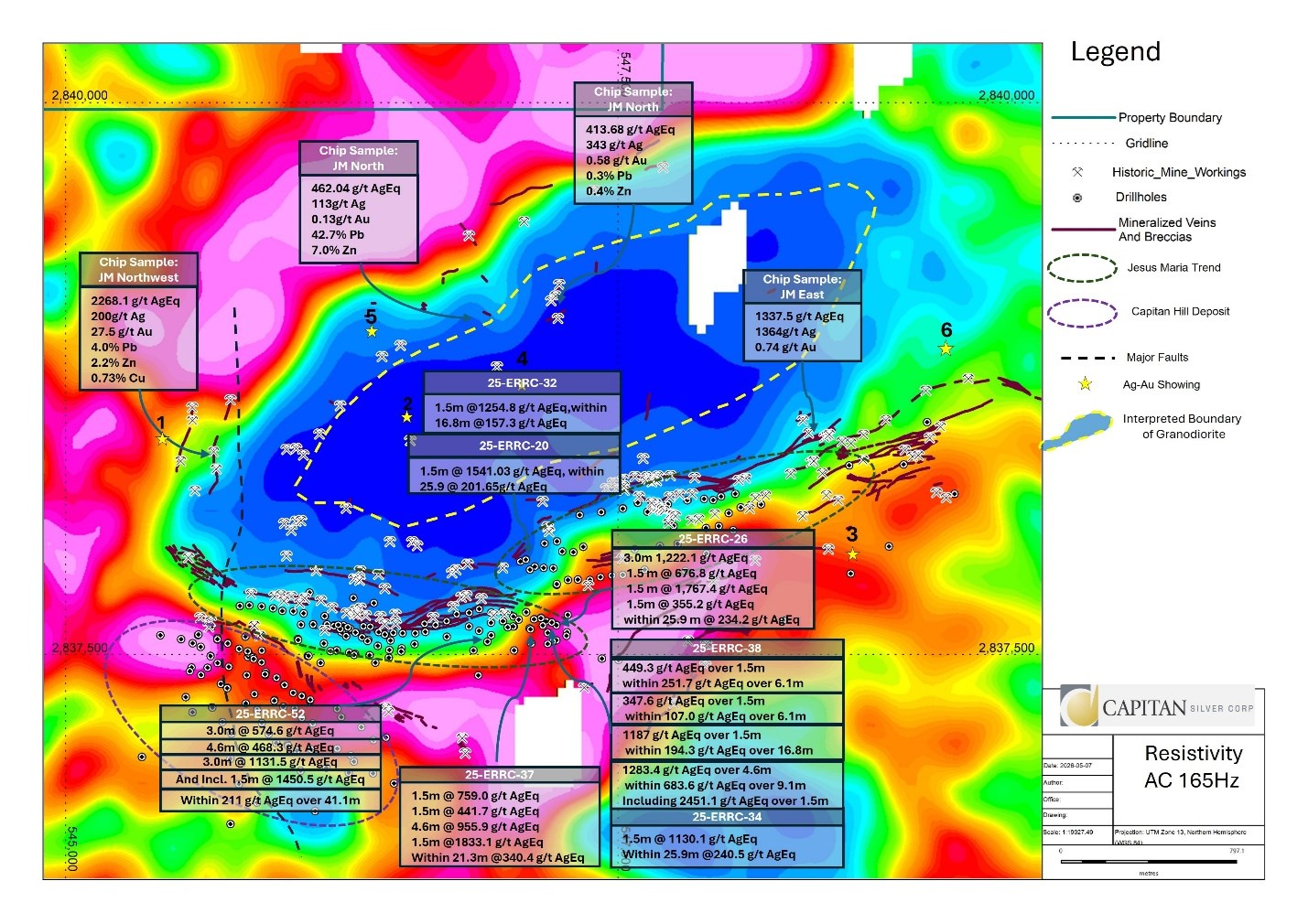
Apparent conductivity (see Figure 2) shows areas of strong contrast matching the mapped boundary between a large, elongated, northeast trending granodioritic intrusive unit (blue shows resistive unit). The immediate area surrounding the intrusive area is the favourable contact that hosts the Jesus Maria Silver Trend. Figure 2B shows a detailed view of this area including a layer of mapped structures on surface and surface sampling and shows a strong match between the high and low resistivity zones between the intrusive and surrounding rocks and mineralized zones. This provides strong new evidence for the continuity of the Jesus Maria Silver Trend to the west and north.
To view an enhanced version of this graphic, please visit:
https://images.newsfilecorp.com/files/7373/296626_fe3543d394814b09_003full.jpg
To view an enhanced version of this graphic, please visit:
https://images.newsfilecorp.com/files/7373/296626_fe3543d394814b09_004full.jpg
To view an enhanced version of this graphic, please visit:
https://images.newsfilecorp.com/files/7373/296626_fe3543d394814b09_005full.jpg
Newly Acquired Magnetic Data
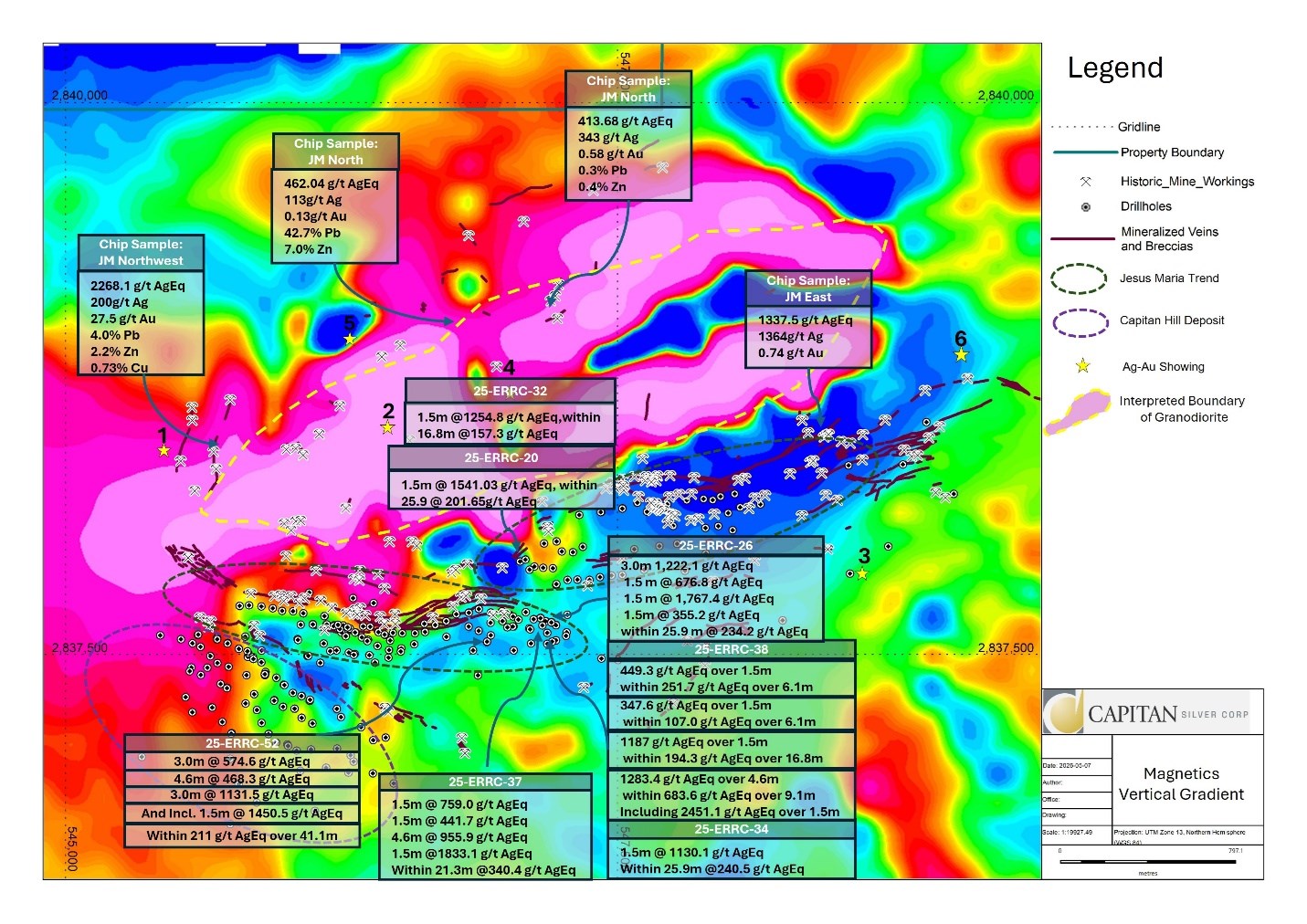
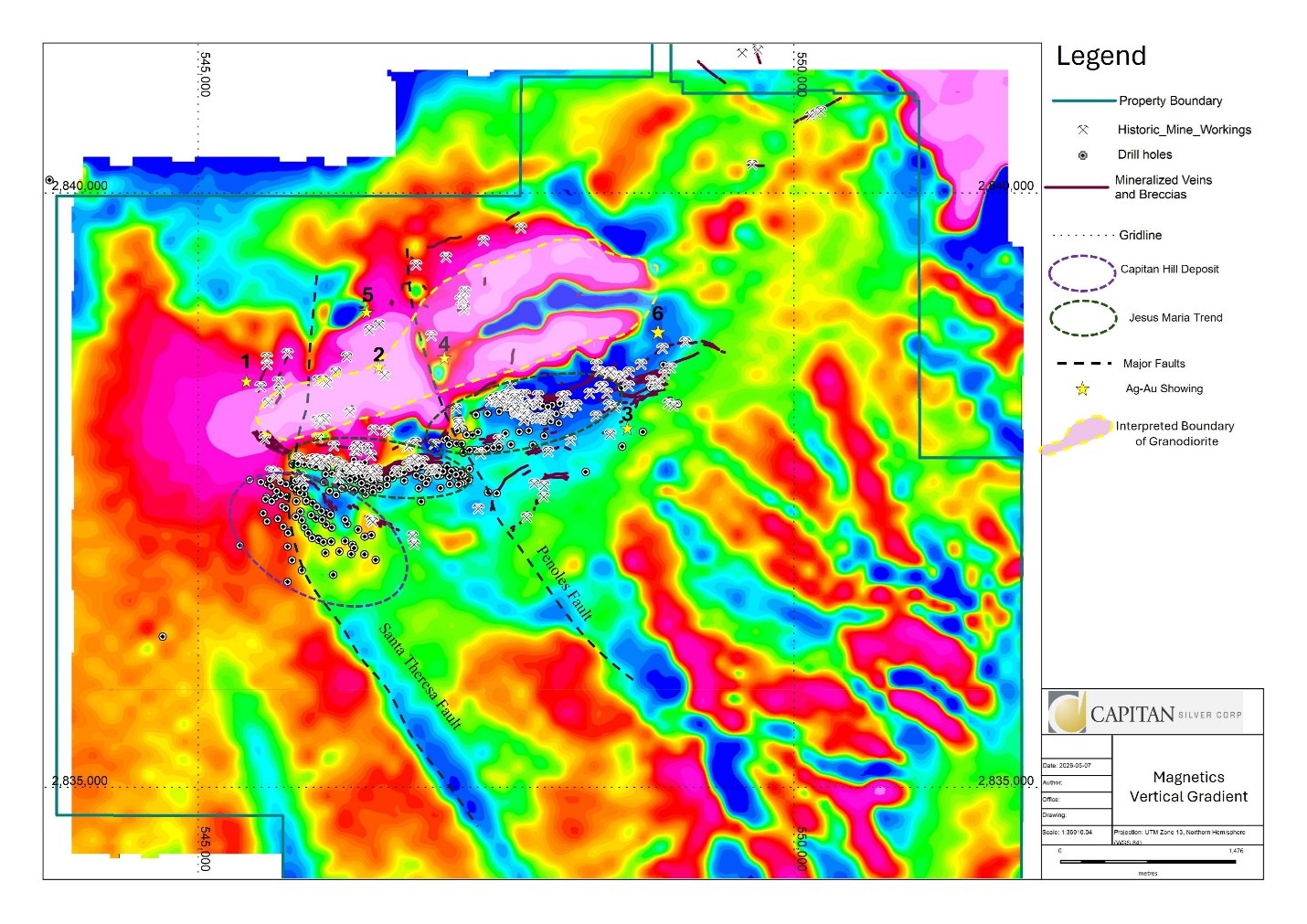
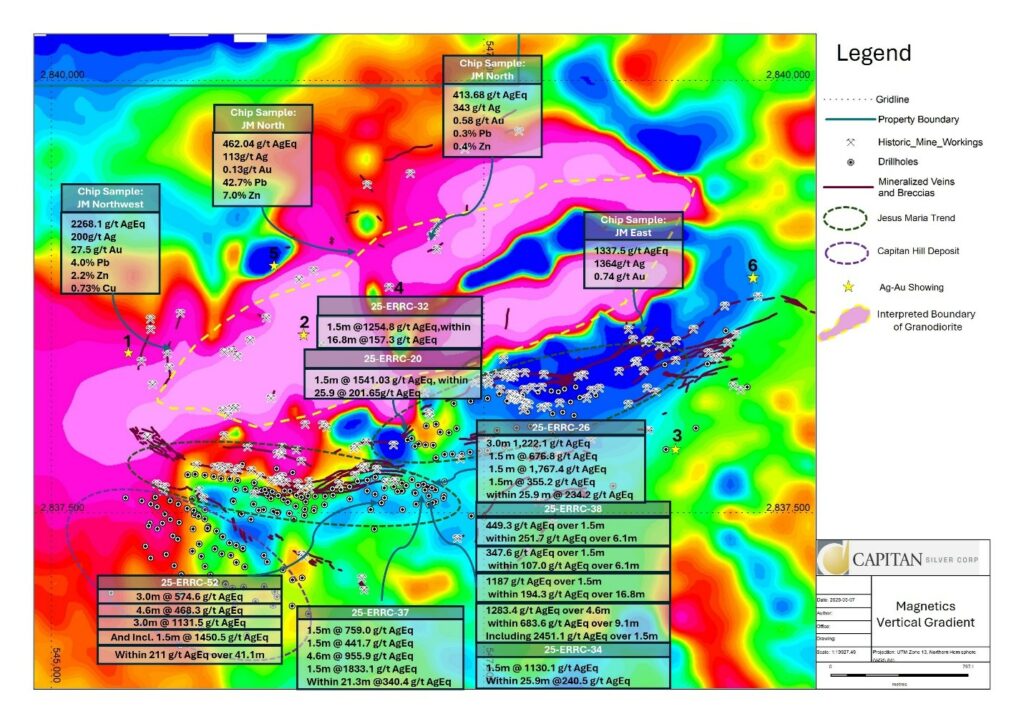
Figure 3 shows the magnetic vertical gradient map from the MT survey. It shows the granodiorite body mainly as a magnetic high and mineralized zones largely matching with magnetic lows. This is particularly clear in the Jesus Maria Silver Trend, west of the Peñoles Fault (where high grades have been intersected in drilling). A similar zone is found on the north end of the intrusive along the Peñoles Fault, indicating a potentially favourable zone for high grade. Additionally, a further pair of elongated lows are found on the eastern end of the magnetic high, one matching the eastern end of the Jesus Maria Silver Trend. The second, located within the intrusive, correlates strongly with the interpreted trend of the previously reported Casco Norte target (Target 4 in Figure 2), where chip sampling returned (4,291.2 g/t AgEq – 62.1 g/t Au, 18.3 g/t Ag, and 0.76% Cu from an old working (see Capitan news release dated October 1, 2025). This further strengthens the Casco Norte target. The anomaly associated with this area trends northeast for approximately 1.3 km and remains untested.
Figure 3A shows a close up of the magnetic vertical gradient map with layered mapped structures, sampling and highlighted drill intercepts, thus offering further detail on the matching magnetic lows and the coincident mineralized structures.
To view an enhanced version of this graphic, please visit:
https://images.newsfilecorp.com/files/7373/296626_fe3543d394814b09_006full.jpg
To view an enhanced version of this graphic, please visit:
https://images.newsfilecorp.com/files/7373/296626_fe3543d394814b09_007full.jpg
Cross-Sections: Implications of New Magnetic and Resistivity Data at the Jesus Maria Silver Trend
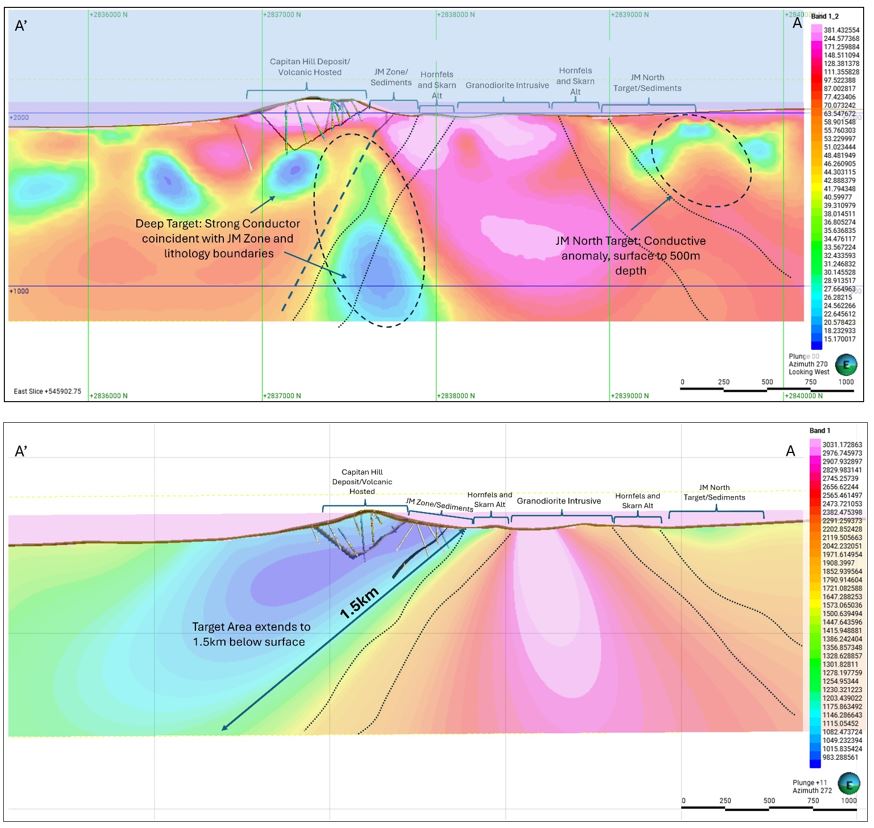
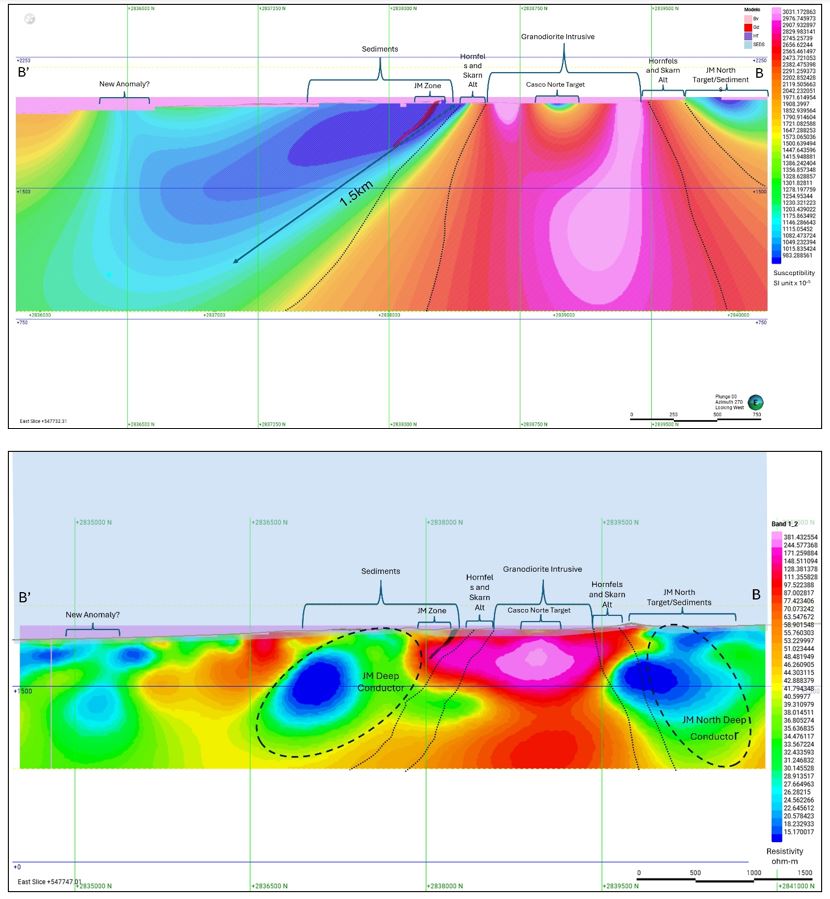
Both Figures 4 and 5 shown below display inverted magnetic susceptibility (top) and inverted resistivity (bottom) data along transects that cross-cut the main Jesus Maria Silver Trend. These two techniques help geologists to delineate boundaries between major rock units, as well trace faults, and detect changes in properties of rock units, that may reflect zones of alteration and mineralization in the subsurface. Cross section A-A’ shows the main Jesus Maria Silver Trend proximal to the historic workings and the Capitan Hill Oxide Gold Deposit (see Figure 4). B-B’ shows the Jesus Maria Silver Trend, east of the Peñoles Fault near the historic San Rafael Mine (see Figure 5). See Figure 1 for location of cross sections.
The sections illustrate favourable zones for mineralization are identifiable within the interpretative products, with the granodiorite reflected in high magnetic susceptibility (magenta)/high resistivity (red-magenta), whereas the areas of altered volcanic and sediment, that host known mineralized zones (Capitan Hill and Jesus Maria), are reflected in the area of low magnetic susceptibility (blue) and low resistivity (green-blue).
Of particular significance is the down-dip projection of these boundaries in the inverted data, which indicates that the favourable horizons for mineralization have continuity of approximately 1.5 km from surface, reinforcing the geological thesis that Cruz de Plata is a deep-rooted, large-scale system. The inverted resistivity images in Figures 4 and 5, illustrate the correlation between areas of strong magnetic contrast (lithological contacts and structures), and areas of strong conductivity at depth.
These areas of conductivity (red areas) – where they overlap with known structures and lithology boundaries – could represent zones of hydrothermal alteration, including zones of brecciation, clay alteration, sulphide bearing zone or altered sediment.
This observation supports Capitan’s thesis of potentially deeper targets beneath known zones of mineralization where feeder structures are transporting mineralized fluids towards surface. It should be noted that mineralized zones such as Capitan Hill, eastern portions of the Jesus Maria Silver Trend (San Rafael Area) and the El Tubo target, represent more near surface (distal) hot-spring style epithermal mineralization, with deeper portions of the system, transitioning to more silver-rich, and eventually becoming more base-metal rich at depth.
Interpretive work and updates will continue in the coming months as field work is carried out. Capitan intends to continue engaging with Expert Geophysics Limited to assist with targeting exercises, particularly for anomalies at depth.
To view an enhanced version of this graphic, please visit:
https://images.newsfilecorp.com/files/7373/296626_cpfig4.jpg
To view an enhanced version of this graphic, please visit:
https://images.newsfilecorp.com/files/7373/296626_cpfig5.jpg
Qualified Person
The scientific and technical information in this news release has been reviewed and approved by Marc Idziszek, P.Geo, Vice President Exploration of Capitan, and a “qualified person” (with the meaning of National Instrument 43-101 – Standards of Disclosure for Mineral Projects).
Assay Disclosure
Metal Recovery: Ag 94%, Au 86%, Pb 93.5%, Zn 92% AgEq considers Ag, Au, Pb and Zn and calculated as follows: AgEq = Ag g/t + (80x Au g/t) + (0.003 x Pb g/t) + (0.0037 x Zn g/t). High grades have not been capped. Surface (Grab and Chip) samples have been analysed by Bureau Veritas using the following codes: MA300, 4-acid digestion, multi-element analysis (Vancouver Lab). Au is analyzed using Fire Assay (FA430, Durango Lab). Overlimit (>200 ppm Ag) assays utilize method MA370, with gravimetric utilized for any overlimit thereafter. Capitan Silver maintains a rigorous QAQC program and inserts multiple standards, blanks and duplicates into the sample stream at regular intervals. Check Assays are performed at SGS laboratories in Durango, Mexico. Grab and Chip samples reported herein are selective by nature and may not be representative of the average grade of the mineralized zones.
About Capitan Silver Corp.
Capitan Silver is defining a new high-grade silver system at its Cruz de Plata project, located in the heart of Mexico’s primary silver belt. The Company is led by a proven and accomplished management team that has previously advanced three projects into production, on time and on budget. The Company has been diligent in maintaining a tight share structure and has one of the tightest share structures among its peer group, with the top three shareholders owning approximately 37% of the Company’s share capital. Capitan Silver is fully funded and actively drilling at its Cruz de Plata silver project.
ON BEHALF OF CAPITAN SILVER CORP.
“Alberto Orozco”
Alberto Orozco, CEO
For Additional Information Contact:
Alberto Orozco, CEO
Capitan Silver Corp.
[email protected]
Greg DiTomaso, Investor Relations
Capitan Silver Corp.
[email protected]
Phone: (416) 433-2801
www.capitansilver.com
CAUTIONARY STATEMENT REGARDING FORWARD-LOOKING INFORMATION
Certain statements contained in this news release constitute “forward-looking statements“ within the meaning of applicable Canadian securities legislation (collectively, “forward-looking statements“). All statements, other than statements of historical fact, contained in this news release are forward-looking statements. These forward-looking statements, by their nature, require Capitan to make certain assumptions and necessarily involve known and unknown risks and uncertainties that could cause actual results to differ materially from those expressed or implied in these forward-looking statements. Forward-looking statements are not guarantees of future performance.
Forward-looking statements may be identified by the use of words or phrases such as “may“, “will“, “would“, “could“, “should“, “expect“, “believe“, “plan“, “anticipate“, “intend“, “estimate“, “continue“, “objective“, “potential“, “target“, “strategy“, “project“, “forecast“, “outlook“, “scheduled“, “seek“, “explore“ and other similar terminology, as well as terms usually used in the future and the conditional, and the negatives thereof, or comparable terminology, are intended to identify forward-looking statements. In particular, but without limiting the foregoing, this news release contains forward-looking statements with respect to: expectations regarding the Company’s 2026 drilling program at the Cruz de Plata project, including the planned 60,000-metre multi-rig program; anticipated timing and results of future assay results; the potential scale, continuity, and grade of mineralization at the Cruz de Plata project; the potential to expand known zones of mineralization; the prospectivity of the Cruz de Plata project and its exploration potential; management’s beliefs regarding the mineralized system at Cruz de Plata; and the Company’s strategy and exploration objectives.
The forward-looking statements contained in this news release are based upon certain material assumptions that were applied in drawing a conclusion or making a forecast or projection, including assumptions and expectations regarding: the continued validity of exploration results and geological interpretations; the ability to complete planned exploration programs on time and within budget; the availability of financing for future exploration and development activities; commodity prices remaining at levels that support continued exploration; the ability to obtain and maintain all necessary permits and approvals; the accuracy of current mineral resource estimates; the continuity of mineralization between drill holes; and general economic and business conditions. Although the Company believes that the assumptions underlying these forward-looking statements are reasonable, they may prove to be incorrect, and the Company cannot assure investors that actual results will be consistent with these forward-looking statements.
Forward-looking statements involve known and unknown risks, uncertainties and other factors which may cause the actual results, performance or achievements of the Company to be materially different from any future results, performance or achievements expressed or implied by the forward-looking statements. Such risks and uncertainties include, but are not limited to: exploration and development risks, including risks related to the interpretation of geological data and exploration results; the uncertainty of mineral resource estimates; risks inherent in the mining industry including environmental hazards, industrial accidents, unusual or unexpected geological formations, pressures, cave-ins, flooding, and the risk of inadequate insurance or inability to obtain insurance; fluctuations in commodity prices; currency exchange rate fluctuations; risks related to obtaining and maintaining necessary permits and licenses; risks related to the Company’s title to its mineral properties; risks related to the political and economic climate in Mexico; regulatory changes; reliance on key personnel; competition in the mining industry; risks related to the Company’s ability to raise additional capital; dilution to existing shareholders; risks related to global economic conditions and market volatility; environmental risks and hazards; and other risks and uncertainties described in the Company’s public filings.
The foregoing list of risks and uncertainties is not exhaustive. For a more complete discussion of the risk factors affecting the Company, readers are encouraged to review the Company’s filings available on SEDAR+ (www.sedarplus.ca) under the Capitan’s issuer profile.
Although the Company has attempted to identify important factors that could cause actual actions, events or results to differ materially from those described in forward-looking statements, there may be other factors that cause actions, events or results to differ from those anticipated, estimated or intended. Forward-looking statements contained herein are made as of the date of this news release and the Company disclaims any obligation to update any forward-looking statements, whether as a result of new information, future events or results or otherwise, except as required by applicable securities laws. There can be no assurance that forward-looking statements will prove to be accurate, as actual results and future events could differ materially from those anticipated in such statements. Accordingly, readers should not place undue reliance on forward-looking statements.
Neither the TSX Venture Exchange nor its Regulation Services Provider (as that term is defined in the policies of the TSX Venture Exchange) accepts responsibility for the adequacy or accuracy of this release. No stock exchange, securities commission or other regulatory authority has approved or disapproved the information contained herein.
Source: Capitan Silver Corp.
Original Press Release: https://www.newsfilecorp.com/release/296626/Capitan-Silver-Receives-Final-Results-from-Airborne-Geophysics-Program-for-the-Cruz-De-Plata-Project