Highlights
- Maiden Exploration Target defined: 1.8 – 5.0 Mt for 70 – 166 kt of contained antimony metal across three discrete zones — Lirios 1 and Lirios 2 (carbonate replacement-style, ~1.8% Sb) and the high-grade Cofradia zone (~6.7% Sb). The Exploration Target is conceptual in nature (see Cautionary Statement).
- Shallow CRD continuity confirmed at Lirios 1: diamond drill hole DDH-L1-08-26 returned 5.25 m @ 1.36% Sb from 8.1 m, including 3.05 m @ 2.12% Sb, with other holes confirming a continuous, near-surface carbonate replacement (CRD) host.
- Same CRD horizon confirmed 6 km along strike at Lirios 2: maiden hole DDH-L2-14-26 returned 2.35 m @ 2.52% Sb from 11.25 m, indicating a mineralised corridor of district-scale potential along the Lirios Fault Zone.
- High-grade Cofradia zone identified: channel sampling at the intersection of two first-order structures returned 2.2 m @ 5.66% Sb by handheld pXRF — indicative results only; laboratory assays are pending (see Cautionary Statement – pXRF).
- Clear targeting pathway established to a maiden Resource: Phase 2 drilling is being designed to test likely high-grade feeder-structure intersections within CRD unit, targeting a maiden JORC Mineral Resource Estimate in 2H CY2026.
- A strategically scarce asset: Los Lirios is one of very few advanced-stage antimony projects in North America, in a market defined by acute, policy-driven supply tightness following China’s 2024 export controls and the absence of meaningful or near-term primary antimony production in the United States.
EV Resources (“EVR” or the “Company”) is pleased to report the establishment of an Exploration Target for the Company’s Los Lirios Antimony Project located in Oaxaca, Mexico. The milestone quantifies the scale of one of North America’s most strategically positioned antimony projects at a time of acute global supply constraint. The Company is also pleased to release additional Phase 1 drill assay results confirming the geological model and validating EVR’s approach ahead of a Phase 2 program designed to materially grow both grade and resource scale.
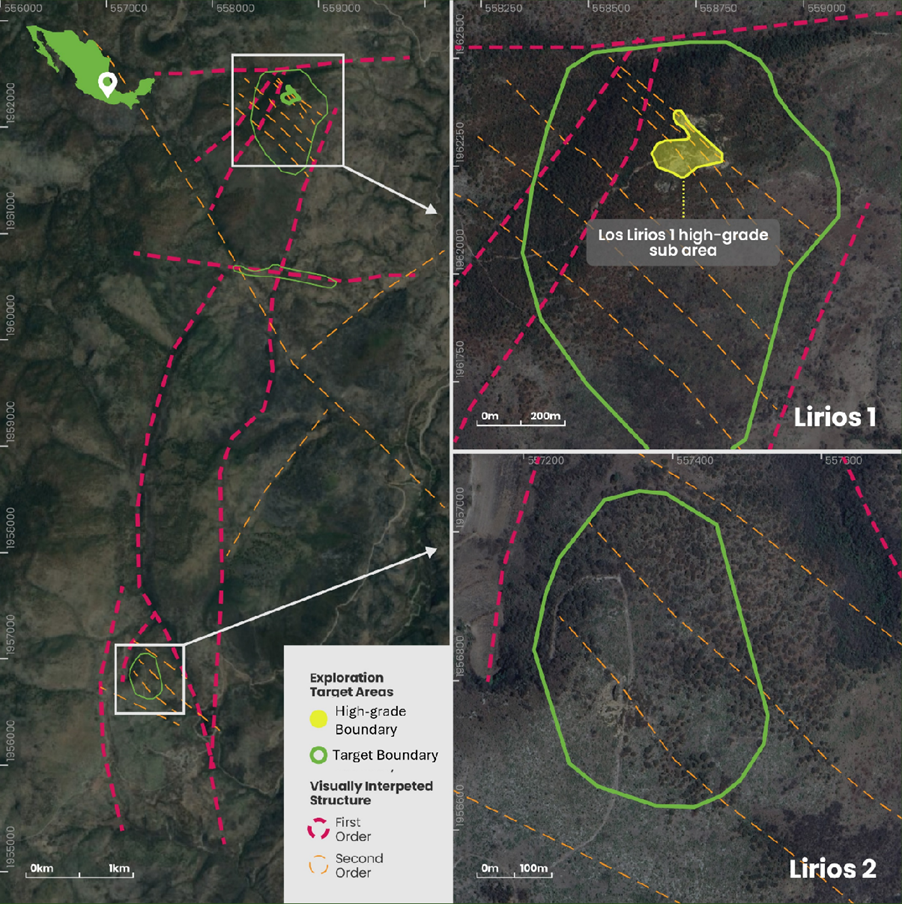
The Los Lirios Antimony Project has now been subject to 15 drill holes, extensive channel sampling, and a CSAMT geophysical survey. Collectively, these data sets underpin an Exploration Target of 1.80 – 5.0 Mt across three mineralisation zones, representing 70 – 166 kt of contained metal. See Figure 1.
Cautionary Statement (Exploration Target): The potential tonnages and grade of an Exploration Target are conceptual in nature. There has been insufficient exploration work to estimate a Mineral Resource as defined by the JORC Code (2012 Edition). It is uncertain whether further exploration will result in sufficient results to enable the estimation of a Mineral Resource. This Exploration Target should not be misconstrued as a Mineral Resource estimate and has been prepared in accordance with the JORC Code (2012 Edition).
EV Resources Managing Director & CEO, Mike Brown, commented: “This maiden Exploration Target is an important milestone that, for the first time, puts a credible scale on what we are building at Los Lirios. What excites us most is that our first-pass drilling
— which was aimed at testing the steep feeder structures — instead revealed a stratabound CRD unit that is continuous, laterally extensive and, to date, very shallow. That is a very strong foundation and a significant achievement. Our planned Phase 2 program is designed to drill the likely high-grade intersections where those feeders meet the CRD host, with short, low-cost holes, and we are confident this gives us a highly capital-efficient pathway toward a maiden JORC Resource.”
“The Cofradia zone is especially encouraging. Two major structures intersecting within a hydrothermal breccia is exactly the setting that can generate both grade and scale, and its position 1.7 km south of Lirios 1 points to the untapped potential across the entire 6 km Lirios Fault Zone corridor. We are moving quickly to assay Cofradia and fold it into our Phase 2 plan. With antimony established as a critical mineral and Western supply under genuine pressure, we believe Los Lirios is emerging at exactly the right time.”
Exploration Target: Scale and Grade Potential Established
The Los Lirios Project Exploration Target has been established on the basis of geological interpretation integrating drill results, channel sampling and geophysical survey data across three discrete zones at Lirios 1, Lirios 2 (northern and southernmost targets respectively) and Cofradia (see Figure 1). Lirios 1 and 2 are representative of a stratigraphic carbonate replacement deposit style unit (CRD).
Table 1: Los Lirios Exploration Target
| Target Area | Tonnage (Mt) | Grade | Contained Sb Metal (kt) | ||
| Lower | Upper | Sb % | Lower | Upper | |
| Los Lirios 1 | 0.97 | 2.8 | 1.8 | 17 | 51 |
| (Including) | 0.06 | 0.09 | 3.7 | 2 | 3 |
| Los Lirios 2 | 0.1 | 0.6 | 1.8 | 2 | 11 |
| Total CRD style | 1.07 | 3.4 | 1.8 | 19 | 62 |
| Cofradia | 0.75 | 1.5 | 6.7 | 50 | 101 |
| TOTAL | 1.8 | 5.0 | 70 | 166 |
Note – Figures may not sum due to rounding.
The target grade of 1.8% Sb applied to the Lirios 1 and 2 CRD zones represents a conservative starting point, reflecting the proportion of CRD-hosted mineralisation in the current drill dataset.
Phase 2 drilling is designed to target feeder intersections within the CRD, where high-grade feeder zones concentrate antimony mineralisation, and is expected to demonstrate higher grades than those implied by the Exploration Target at the CRD zones. The Cofradia zone, at an average 6.7% Sb, reflects a distinct, structurally controlled, high-grade target area.
Basis for the Exploration Target
The tonnage ranges reflect the uncertainty inherent in early-stage exploration. The Exploration Target has been established on the basis of geological interpretation of the project area in the context of stratiform Carbonate Replacement Deposit (CRD) style mineralisation, tightly structurally controlled high-grade vein mineralisation, drilling results, channel sampling, mapping and extrapolation of mineralisation based on geophysical survey results. Specific sources of uncertainty include:
- Variability and continuity of thickness and lateral extent of CRD units,
- Prevalence of intersecting feeder structures within CRD mineralisation,
- Variability in the prevalence of semi-massive veining at Cofradia, and
- Potential depth variability of semi-massive veining at Cofradia
Lirios 1 and 2 represent CRD-style targets resulting from the intersection of sub-vertically dipping second-order feeder faults, which strike generally northwest, within calcareous sediments (limestones) that have been gently, and openly folded along axial planes that strike approximately east-northeast at Lirios 1 and north-south at Lirios 2. This structural configuration has produced high-grade, narrow zones along these structures within a broader, sub horizontal zone of silica-sulphide replacement within the limestones (See previous ASX announcement dated 12 May 2026).
The Cofradia target comprises a zone of intense hydrothermal brecciation hosted within the same limestone sequence, hosting a series of siliceous veinlets containing semi-massive stibnite (± cervantite). The Cofradia target appears to be coincident with the intersection of two first-order, deeper crustal-tapping structures striking generally east-west and north-south.
Mineralisation across all three zones is characterised by variable percentages of cervantite and stibnite replacing the calcareous host within silicified zones. Grades correlate directly with the proportion of stibnite and/or cervantite present, a relationship that underpins the exploration model for Phase 2 targeting of feeder-structure intersections within the CRD, where stibnite concentrations are highest.
Phase 1 Drilling: CRD Continuity Confirmed at Lirios 1
Phase 1 diamond drilling at Lirios 1 was designed to test the extent and continuity of the Carbonate Replacement Deposit (CRD) unit across the project area, providing the stratigraphic framework for subsequent resource-delineation drilling. Drill orientations in this phase targeted CRD unit intersection rather than feeder structure intersections, the latter being the primary high-grade target for Phase 2.
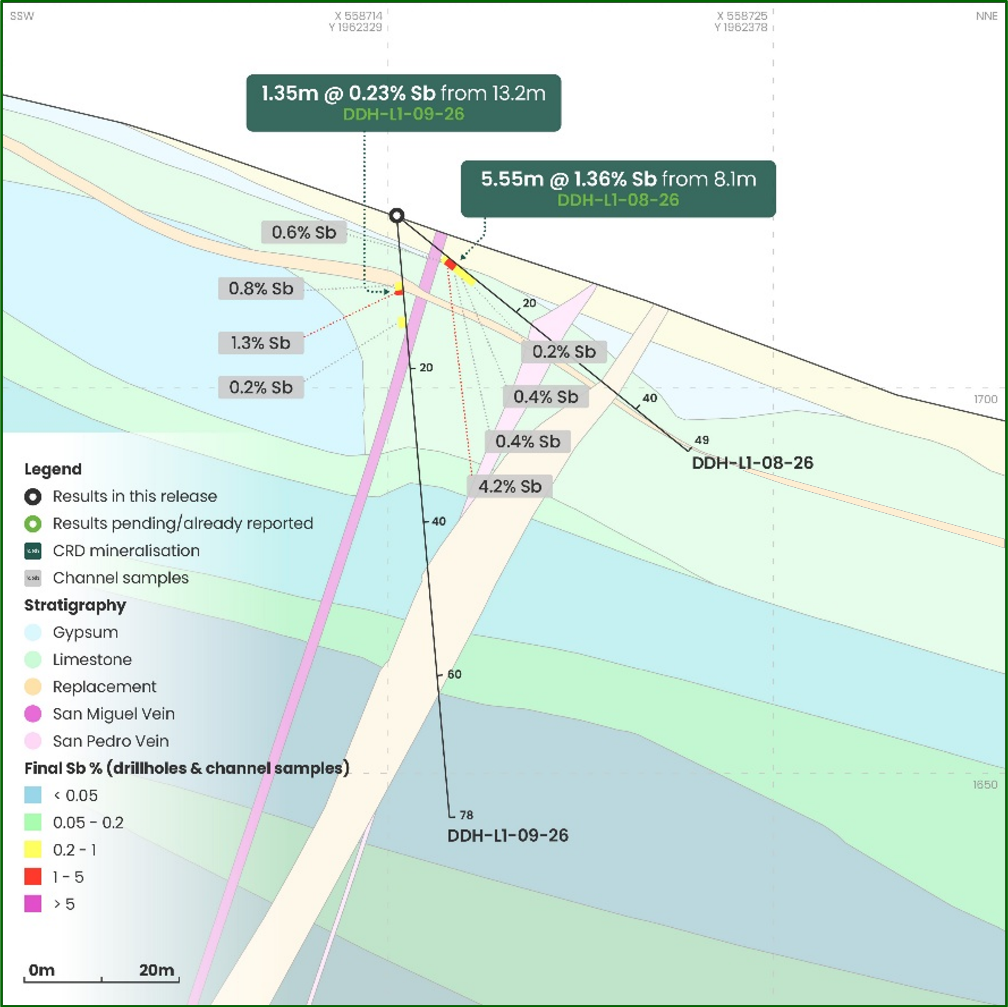
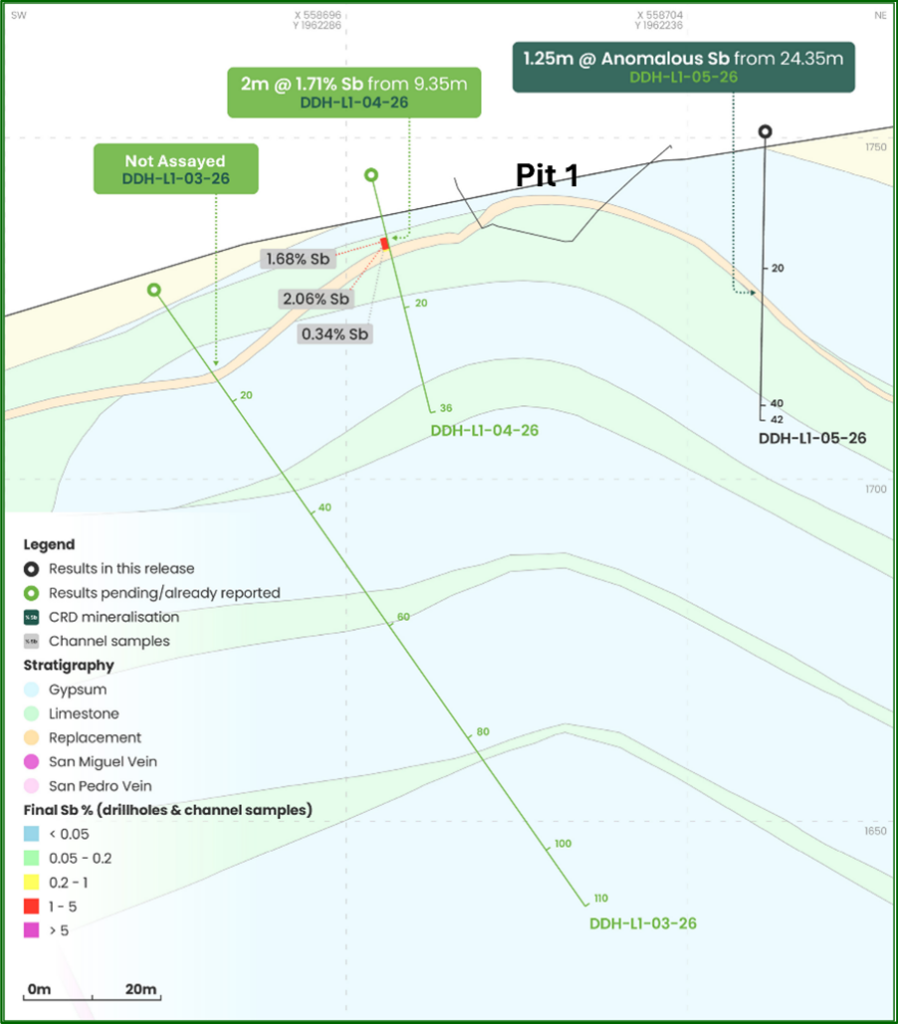
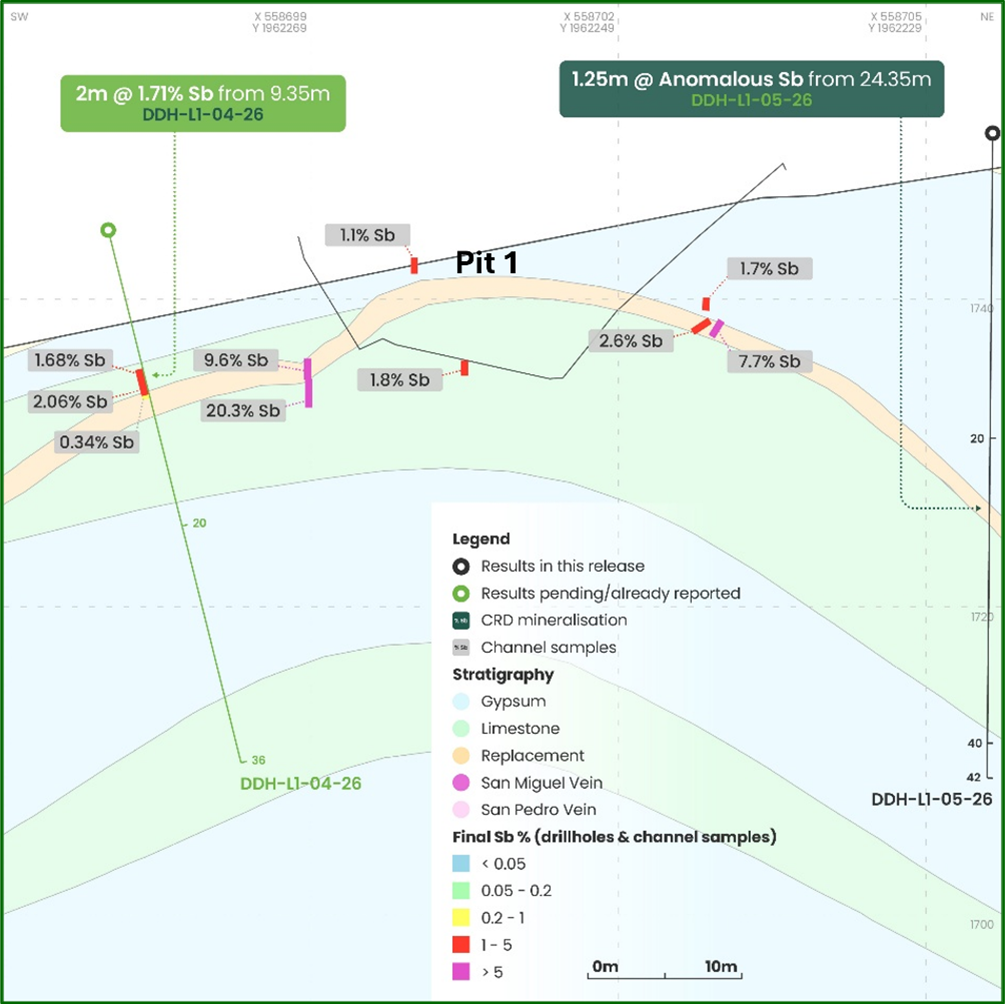
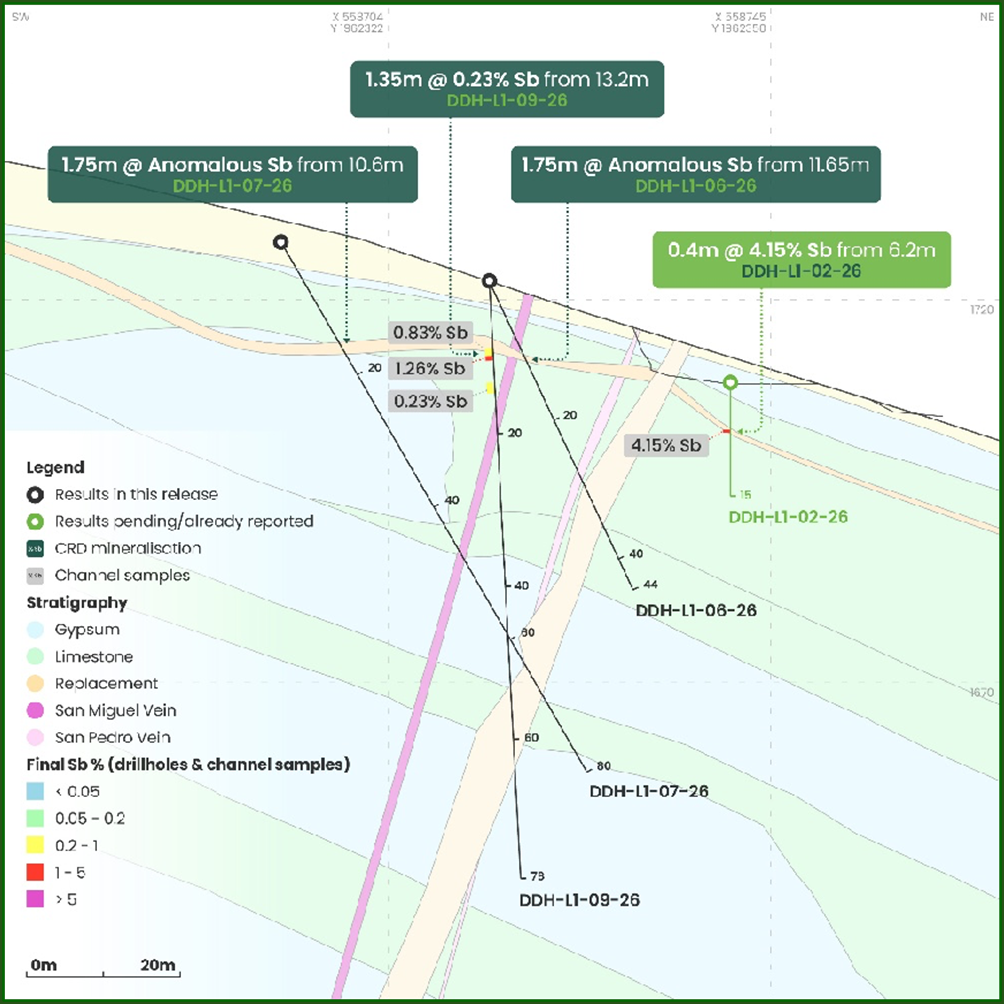
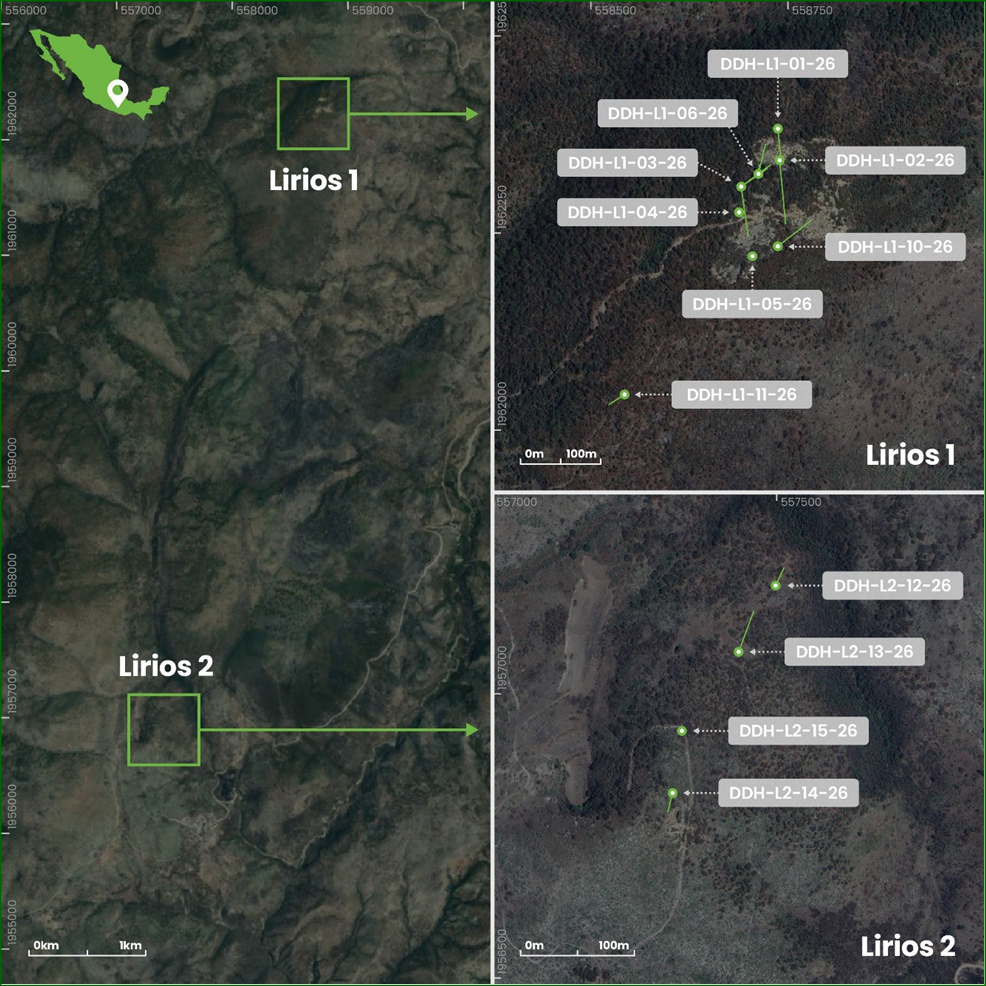
The best Phase 1 result from Lirios 1 is hole DDH-L1-08-26, returning 5.25m @ 1.36% Sb from 8.1m, including 3.05m @ 2.12% Sb from 8.1m. This hole was drilled at a shallow angle to confirm the San Pedro structure, which strikes northwest, parallel to the San Miguel feeder structure. Holes DDH-L1-05-26, DDH-L1-06-26, DDH-L1-07-26 and DDH-L1-10-26 all
intercepted the silicified CRD unit at expected depths, but only anomalous antimony reported. This is seen indicative of proximity to a feeder structure strongly controlling antimony distribution. The drilling confirms shallow CRD mineralisation at elevations amenable to open-cut extraction and validates the geological model of pervasive silica-sulphide replacement within folded calcareous sediments along the Lirios Fault Zone (LFZ) corridor.
Table 2: Phase 1 Drilling Significant Intercepts. Lirios 1 and 2
| Hole ID | From (m) | To (m) | Length (m) | Sb (%):XRF15c | Intersection |
| DDH-L1-08-26 | 8.10 | 13.35 | 5.25 | 1.36 | 5.25m @ 1.36% Sb from 8.1m, incl. 3.05m @ 2.12% Sb from 8.10m |
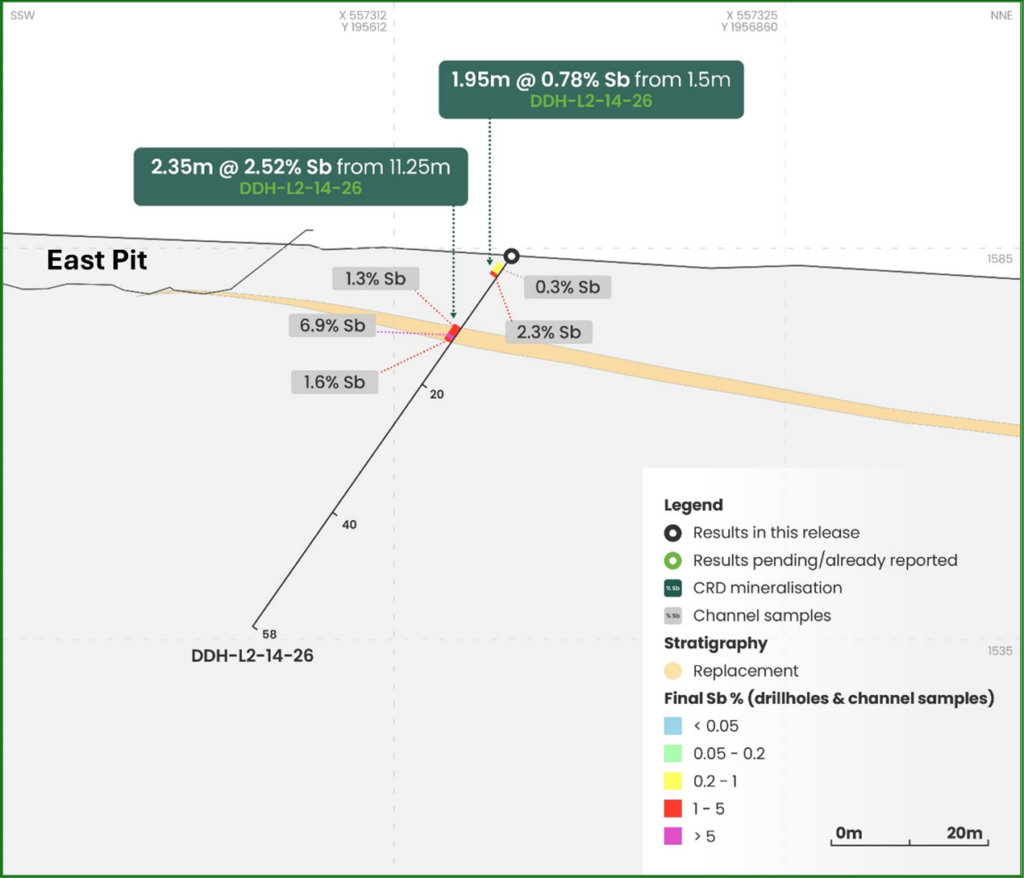
| DDH-L2-14-26 | 1.50 | 3.45 | 1.95 | 0.78 | 1.95m @ 0.78% Sb from 1.50m |
| DDH-L2-14-26 | 11.25 | 13.60 | 2.35 | 2.52 | 2.35m @ 2.52% Sb from 11.25m |
Note: All widths are downhole widths. DDH-L1-08-26 partially reported previously (see prior announcement dated 12 May 2026). See Appendix A for all results and true widths.
Lirios 2: CRD Confirmed
The first drill hole at Lirios 2 (DDH-L2-14-26) has confirmed CRD mineralisation at shallow depth, returning 2.35m @ 2.52% Sb from 11.25m and 1.95m @ 0.78% Sb from 1.5m (see Figure 6). The CRD unit and overlying gypsum stratigraphy at Lirios 2 are geologically identical to those observed at Lirios 1, interpreted as the same stratigraphic unit despite being approximately 6km apart along the LFZ corridor. The hole is approximately 30m to north of the East Pit workings, angled to the SSW to intersect the NW trending structure channel sample that returned 30.2% Sb1.
This has significant implication for project scale. The LFZ corridor is interpreted as a long-lived structural conduit for hydrothermal antimony mineralisation, and continuity of the CRD host over 6km opens the potential for substantial resource growth through Phase 2 step-out drilling. The near-surface nature of the Lirios 2 CRD intersection is a positive indicator for future development flexibility.
1 Refer ASX Announcement “Exceptional Channel Sampling Results up to 30.2% Sb” 24 February 2026
New High-Grade Zone Identified at La Cofradia
Field reconnaissance has identified a zone of intense hydrothermal brecciation at Cofradia, at the interpreted intersection of two first-order structural lineaments, a northwest-striking and an east-northeast-striking structure (see Figure 7). An historical adit into this breccia zone has been mapped and sampled using a handheld diamond saw and assayed with a handheld pXRF analyser returning a significant channel sample:
- 2.2m @ 5.66% Sb
Stibnite and cervantite are confirmed in dense quartz veinlet networks crosscutting the hydrothermal breccia host. The structural setting (intersection of two deep-crustal tapping structures) is a highly prospective environment for high-grade antimony mineralisation and is consistent with mineralised primary feeder zone architecture observed at Lirios 1. See Appendix C for channel sampling details.
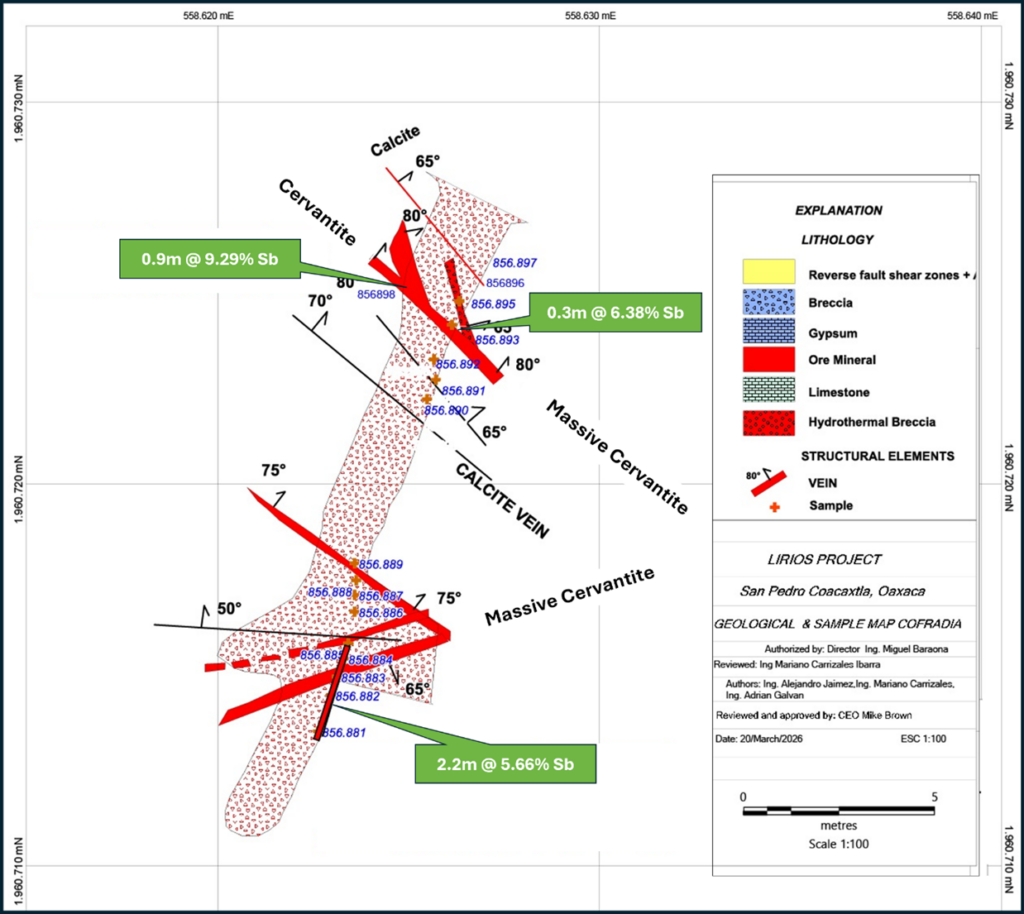
Laboratory assay samples have been submitted, and results are pending. Visual estimates of acicular stibnite and cervantite of up to 10% in the mineralised sections corresponds extremely closely with the averaged pXRF values for each sample (see Appendix C). Subject to assay confirmation, the Cofradia zone will be integrated into Phase 2 drill targeting as a priority high-grade exploration objective.
Cautionary Statement (pXRF Results): The pXRF results reported for Cofradia should be treated as indicative only. Handheld XRF analyses are not a substitute for laboratory assay results, and the values presented may differ materially from certified laboratory assay values. Results will be verified by standard laboratory assay. No resource statement or definitive conclusions regarding grade or continuity should be drawn from pXRF data alone.
North American Antimony Supply
Antimony is designated a critical mineral by the U\S, EU and Australian governments, with application across national defence (armour-piercing munitions night-vision devices, infrared sensors), grid-scale energy storage, flame retardants and semiconductors. China’s imposition of antimony export restrictions in August 2024 has placed acute pressure on Western supply chains, with no meaningful domestic US antimony production currently in operation.
Los Lirios is one of very few advanced antimony projects in North America with demonstrated high-grade mineralisation at surface, a confirmed processing pathway with >90% recovery, and an active development program. The project’s scale potential, now framed by an Exploration Target of up to 166kt of contained antimony metal across three zones, positions EVR as a meaningful potential contributor to North American critical minerals supply. CRD hosted antimony deposits represent over 60% of the world’s antimony production, including the largest antimony mine in the world within China’s Xikuangshan antimony belt- representing large-scale long-life deposit types.
Forward Plan and Next Steps
- Receive Cofradia laboratory assay results and integrate with structural mapping to define Phase 2 high-grade drill targets.
- Complete CSAMT geophysical interpretation at Lirios 2 and integrate with Phase 1 drilling dataset to finalise Phase 2 step-out drill targets at feeder structure intersections.
- Receive and report remaining Phase 1 assay results (DDH-L2-15-26 pending).
- Phase 2 drill program targeting the CRD unit and intersections with feeder structures, in particular at Los Lirios 1 and Los Lirios 2, step-outs and Cofradia structures.
- Advance maiden JORC Mineral Resource Estimate, targeted 2H CY2026.
– ENDS –
This announcement was authorised for release by the Board of EV Resources Ltd.
For further information, please contact:
Mike Brown
Managing Director
Tel: +61 8 6489 0600
E: [email protected]
Source: EV Resources Limited
Original Press Release: https://api.investi.com.au/api/announcements/evr/2d00ae0a-3fe.pdf