Results provide immediate drill targets and vectors
Highlights
- Footprint and Scale Extended: Geophysical survey indicates that the hydrothermal system extends well beyond the boundaries of Phase 1 drilling, defining two high-priority targets and a vectoring tool for feeder-controlled mineralisation.
- Extensive Untested Conductor: A very large, open, low-resistivity anomaly has been delineated across all five survey lines, located approximately 500m southeast of current drilling. The structural-stratigraphic signature is consistent with a large-scale sulphide replacement system.
- Inferred Fluid Feeder Conduit: Advanced processing has resolved a distinct, deep-rooting anomaly to the immediate east of shallow Phase 1 drilling, interpreted as a primary structural conduit for mineralizing fluids.
- Structural Targeting Framework: Mapping of the vertical fault network provides a clear structural framework parallel to known mineralised trends, establishing precise vectoring parameters for the near-term drill program.
- Phase 2 Technical Integration: On-ground field verification is currently underway to correlate geophysical anomalies with surface geology and geochemistry, directly informing final drill-hole planning ahead of a targeted maiden JORC Mineral Resource Estimate (MRE)
EV Resources (“EVR” or the “Company”) is pleased to announce the completion and interpretation of a 2D inversion model from a Controlled Source Audio-frequency Magneto-Telluric (CSAMT) ground geophysical survey at Lirios 1 within the Los Lirios Antimony Project in Oaxaca, Mexico.The survey has returned three compelling targets for follow-up including a potential sulphide feeder zone at depth and adjacent to existing drilling, a massive untested and open anomaly to the southeast and a project-wide structural network expected to play a critical role in controlling mineralisation. The two low-resistivity anomalies are interpreted as potential sulphide enriched units, zones and/or structures, based on the very high resistivity (low conductivity) of limestone and gypsum country rock. Critically, these results demonstrate that the mineralised system remains open and possesses scale potential significantly larger than previously recognized, directly fast-tracking EVR’s exploration strategy to a maiden JORC Mineral Resource Estimate (MRE) amidst a highly favourable global antimony market.
Three critical outcomes have been established from the interpretation of results:
1. Central Low-Resistivity Anomaly (Potential Feeder Zone)
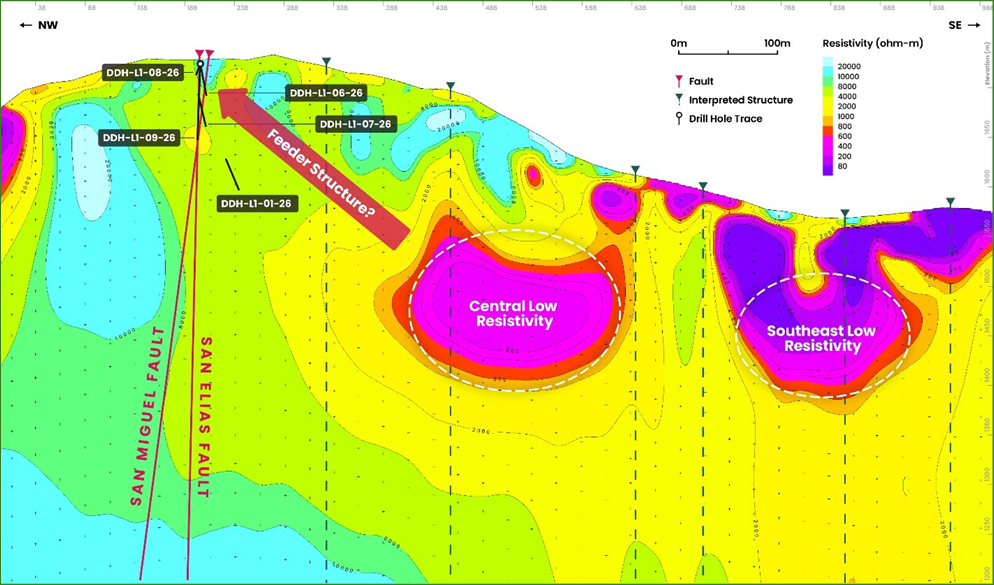
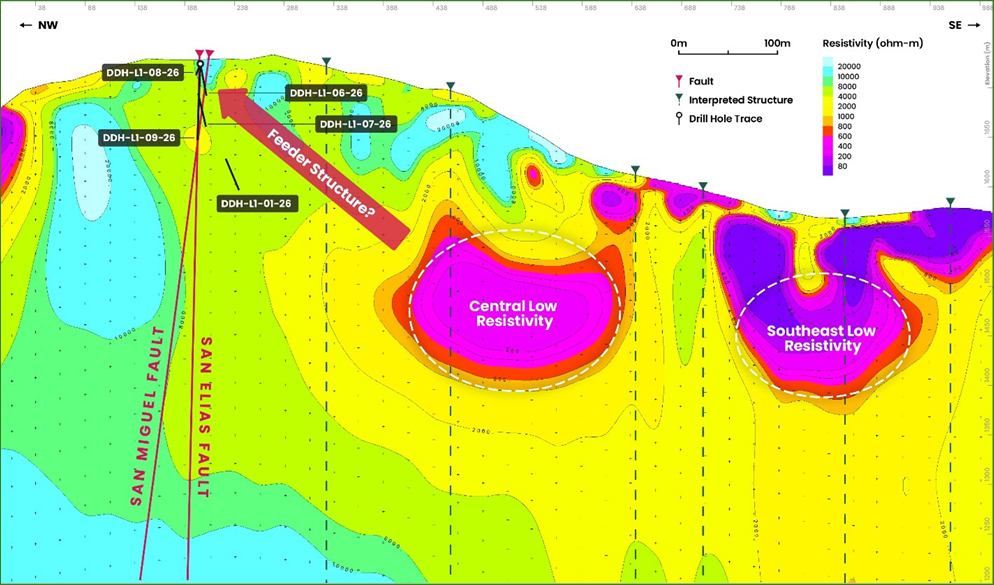
The survey has imaged a distinct low-resistivity anomaly immediately east of the primary drilling cluster on Line 2 and extending northwards through Line 1, remaining open (see Figures 1 and 2). The shallow antimony mineralisation intersected in Phase 1 drilling—which included 3.1m @ 2.1% Sb from 8.1m1 represents a tabular, conductive target hosted within a highly resistive limestone package. The newly identified central anomaly is structurally aligned with this shallow mineralisation but extends at depth. It is interpreted as a structurally focused, sub-vertical conduit representing the primary feeder zone of the system, offering an immediate target for deeper testing.
2. Large Southeast (SE) Conductor Anomaly
Observed consistently across all five survey lines, and open to strike to north, south and east, the SE anomaly presents a significant exploration target (see Figure 1 and 2). The anomaly displays a strong vertical low-resistivity signature associated with structural boundaries, which then “blooms” into an extensive horizontally oriented low-resistivity zone. This specific structural-stratigraphic signature is typical of high-grade sulphide replacement styles within carbonate packages and provides an immediate target for the next phase of drilling.
3. Critical Structural Network of Vertical Faults
Hydrothermal fluid flow in Carbonate Replacement Deposits (CRDs) requires structural pathways (feeders) for fluids to interact with receptive limestone units. The survey delineated multiple sub-parallel vertical features and lineaments bounding the low-resistivity target zones (see Figure 1 and 2). Critically these are parallel to the two known feeder structures, San Elias and San Miguel, providing high-potential targeting vectors for drilling where these newly identified structures intersect the receptive limestone unit.
Pit wall channel sampling indicates that antimony grade distribution within the CRD unit is highly elevated in the immediate vicinity of these feeder structures and diminishes laterally.
1 Refer ASX announcement “Maiden Drilling Confirms Extensive Shallow Antimony System at Los Lirios” dated 12 May 2026
Delineating the fault network allows EVR to accurately predict where fluid interaction was highest, providing a potential roadmap for localised high-grade zones.
EV Resources Managing Director & CEO, Mike Brown, commented: “The results from this CSAMT survey represent a highly encouraging step forward for the scale potential of Los Lirios antimony project. By successfully mapping a robust network of vertical fault structures we now possess a critical vectoring tool to target high-grade zones within this CRD system.
The data has delivered more than what we’d hoped for: a potential sub-vertical connected sulphide feeder zone to the east of our initial drilling, and a massive, coherent and open anomaly to the southeast that significantly increases the scale potential given the strength and size of the anomaly. The southeastern signature is classic for major sulphide/quartz systems and gives us an immediate, high-priority target to test with the drill rig.
These results will feed directly into the planning phase for our Phase 2 drill program. Our strategy here is clear and aggressive: test these highly prospective structural corridors, where hydrothermal fluids interaction with the receptive tabular limestone unit is optimised, expand the mineralisation footprint testing the potential sulphide anomalies and accelerate towards a maiden JORC Mineral Resource Estimate.”
Technical Overview & Detailed Results
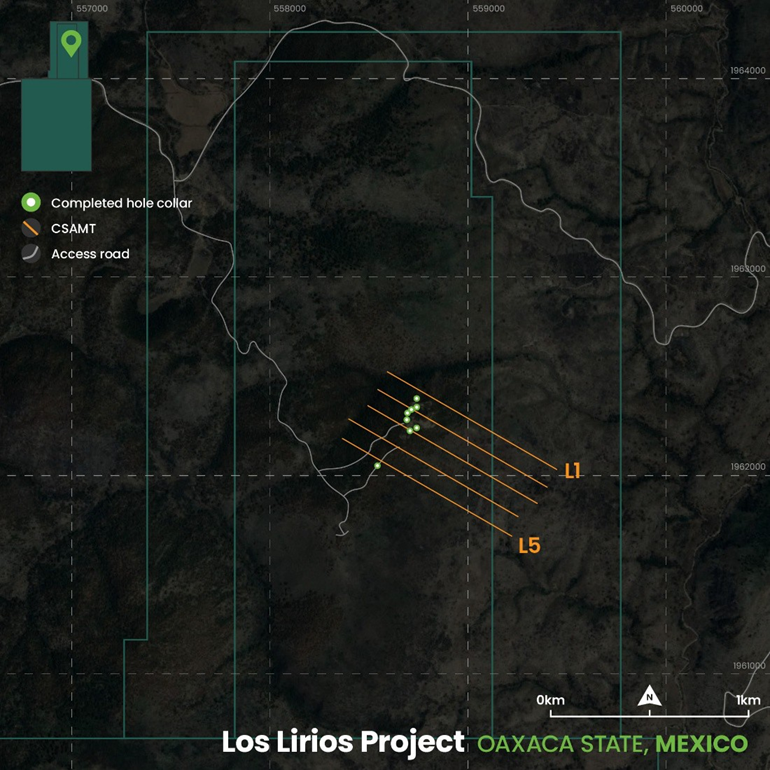
The primary objective of the survey was to map subsurface conductivity changes across a 500-meter vertical window to identify potentially hidden zones of sulphide accumulation and feeder structures to establish a potential geophysical fingerprint for mineralisation. The survey, comprised of five lines spaced 100 meters apart with 25-meter dipoles, was collected and processed by Zonge International and validated and interpreted by SouthernRock Geophysics. See Figure 3.
The 2D inversion effectively imaged a highly dynamic environment, ranging from highly resistive unaltered limestone (>10,000 ohm-m) to zones of low-resistivity (<40 ohm-m), potentially hosting higher conductivity sulphides.
Table 1: Summary of Significant Interpretations from CSAMT survey at Lirios 1
| Target Zone | Geophysical Signature | Interpretation |
| Lines 1 & 2 (East) | Moderately low-resistivity, depth extension, open to north | Potential sub-vertical sulphide feeder zone for shallow CRD mineralisation |
| Southeast (All Lines) | Large, coherent vertical and extensive horizontal anomaly, open to north, south and east | Extensive low-resistivity (sulphide?) replacement system |
| Project-Wide | Distinct sub-vertical resistivity lineaments and offsets | Network of vertical feeder faults |
Geology and CSAMT Discussion
The 2D inversion images a coherent volume from surface to approximately 500 m depth across the survey grid and estimates a dynamic range in resistivity of 40 Ωm to over 15,000 Ωm. The upper end of the resistivity range is typical of the unaltered limestone host and appears as a highly resistivity background. Zones of low to moderate resistivity may be associated with sulphide mineralisation, alteration, or structurally damaged and fluid-bearing carbonate facies.
The antimony mineralisation intersected in Phase 1 drilling represents a thin conductive target in a predominantly resistive limestone host of over 10,000 Ωm. The resulting response and 2D inversion model resistivity in the region of the drilling is likely understated in the model. The true extent and grade of mineralisation may be greater than the current survey response alone suggests, reinforcing the case for targeted Phase 2 drilling to test the newly identified anomalies at depth.
Forward Plan and Next Steps
Field crews are currently conducting ground verification across these newly identified anomalies, correlating geophysical data with surface geology and geochemistry, which will be used to refine final pad locations for Phase 2 drilling program.
The program will focus on generating the required drill density to produce a maiden JORC Mineral Resource Estimate (MRE) for the project as well as testing the highly prospective SE anomaly, to potentially expand on the known mineralised zones.
- Complete field verification: Correlating surface geology, interpretated structural network and the two low-resistivity anomalies identified in the CSAMT
- Completion of CSMAT interpretation of Lirios 2 area, with results to be integrated into the broader project-scale targeting model to expand project-wide pipeline of targets
- Establish an Exploration Target: Complete review of all geological and geophysical data on the Project area to establish an Exploration Target for antimony at Los Lirios
- Phase 2 Rig Mobilization: Advance drill planning over; a) the known zones to underpin the maiden JORC Mineral Resource Estimate (MRE), and, b) testing the step-out potential of the Central and SE anomalies
– ENDS –
This announcement was authorised for release by the Board of EV Resources Ltd.
For further information, please contact:
Mike Brown
Managing Director
Tel: +61 8 6489 0600
E: [email protected]
Compliance Statement
This announcement contains exploration results from the Los Lirios Project extracted from an ASX market announcement dated 12 May 2026 and reported in accordance with the 2012 edition of the “Australasian Code for Reporting of Exploration Results, Mineral Resources and Ore Reserves” (“2012 JORC Code”). The competent person for that announcement was Mr Mike Brown. EVR confirms that it is not aware of any new information or data that materially affects the information included in the original ASX market announcement. The Company confirms that the form and context in which the Competent Person’s findings are presented have not been materially modified from the original market announcement.
Competent Person Statement
The information in this release that relates to geophysical survey results is based on information prepared by SouthernRock Geophysics and reviewed and analysed by Mr Mike Brown who is a Member of the Australian Institute of Geoscientists (MAIG). Mr Brown is the Managing Director and CEO of EVR. Mr Brown has sufficient experience which is relevant to the style of mineralisation and type of deposit under consideration and to the activity which he is undertaking to qualify as a Competent Person as defined in the 2012 Edition of the “Australasian Code for Reporting of Exploration Results, Mineral Resources and Ore Reserves”. Mr Brown consents to the inclusion in this announcement of the matters based on information in the form and context in which it appears.
Forward Looking Statement
Forward Looking Statements regarding EVR´s plans with respect to its mineral properties and programs are statements that are not historical facts. Words such as “expect(s)”, “feel(s)”, “believe(s)”, “will”, “may”, “anticipate(s)”, “potential(s)”and similar expressions are intended to identify forward-looking statements. These statements include, but are not limited to statements regarding future production, resources or reserves and exploration results. All of such statements are subject to certain risks and uncertainties, many of which are difficult to predict and generally beyond the control of the company, that could cause actual results to differ materially from those expressed in, or implied or projected by, the forward-looking information and statements. There can be no assurance that EVR’s plans for development of its mineral properties will proceed as currently expected. There can also be no assurance that EVR will be able to confirm the presence of additional mineral resources, that any mineralisation will prove to be economic or that a mine will successfully be developed on any of EVR’s mineral properties. The performance of EVR may be influenced by a number of factors which are outside the control of the Company and its Directors, staff, and contractors.
These risks and uncertainties include, but are not limited to: (i) those relating to the interpretation of drill results, the geology, grade and continuity of mineral deposits and conclusions of economic evaluations,
(ii) risks relating to possible variations in reserves, grade, planned mining dilution and ore loss, or recovery rates and changes in project parameters as plans continue to be refined, (iii) the potential for delays in exploration or development activities or the completion of feasibility studies, (iv) risks related to commodity price and foreign exchange rate fluctuations, (v) risks related to failure to obtain adequate financing on a timely basis and on acceptable terms or delays in obtaining governmental approvals or in the completion of development or construction activities, and (vi) other risks and uncertainties related to the company’s prospects, properties and business strategy. Our audience is cautioned not to place undue reliance on these forward-looking statements that speak only as of the date hereof, and we do not undertake any obligation to revise and disseminate forward-looking statements to reflect events or circumstances after the date hereof, or to reflect the occurrence of or non-occurrence of any events.
About EV Resources
EV Resources (ASX: EVR) is a critical minerals exploration and development company focused on securing the North American antimony supply chain.
We are rapidly transitioning from a diversified explorer to an expected near-term antimony producer. Antimony is a designated critical mineral by the US, EU, and Australia, with applications in energy storage, battery technology, defence, and high-tech applications.
Our asset portfolio is strategically positioned in mining-friendly jurisdictions:
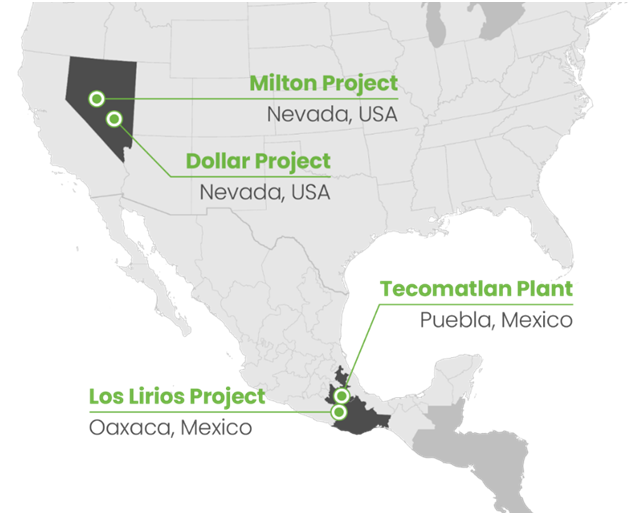
- Tecomatlán Processing Plant, (Mexico). Targeting a near term low CAPEX path to becoming an antimony producer. Refurbishment and installing a gravitational concentrator circuit is underway, providing a low cost highly efficient processing path for antimony, initially processing 3rd party sourced ore and eventually Los Lirios material.
- Los Lirios Antimony Project (Mexico): Our flagship, high-grade antimony project, 50km from the Tecomatlán plant. First-pass drilling has confirmed a laterally extensive CRD system, with advancement towards a maiden JORC Resource delineation underway.
- US Antimony Projects – Dollar and Milton (Nevada): 100%-owned assets strategically positioned to support the US domestic critical minerals supply chain, aligned with US government antimony designation priorities.
Source: EV Resources Limited
Original Press Release: https://api.investi.com.au/api/announcements/evr/95cf48aa-42b.pdf