HIGHLIGHTS
- Exceptional High-Grade Results: Channel sampling at historical pits returns widespread high-grade antimony mineralisation at surface, including:
- 30.2% Sb reported from 0.5m channel at Lirios 2 East pit
- 22.6% Sb reported from 0.8m channel at Pit 5, Lirios 1
- Dual Mineralisation Styles Confirmed: High-grade mineralisation confirmed in both fault/vein hosted conduits and strata bound limestone hosted (carbonate replacement deposit) settings considered to indicate presence of a significant hydrothermal system.
- Significant Scale Potential: Mineralisation confirmed at Lirios 1 and Lirios 2, located ~5.5km apart along the same northerly trending Lirios Fault (LFZ), which acted as a principal conduit for hydrothermal fluids.
- Exploration Upside: The 6km long LFZ structure remains largely untested and will be subject to more detailed exploration at the completion of the current drilling program.
- Multiple Overlimit Samples: Investigation of 16 overlimit samples (>10,000ppm Sb) identified XRF Fusion as the most robust technique for high-grade stibnite. Comparative testing of select samples <1%Sb also returned a significant increase in reportable antimony utilising this method.
- Drilling Underway: A maiden diamond drill program is currently progressing at Lirios 1 to test the depth and strike continuity of both the structural and CRD mineralisation styles.
EV Resources (ASX: EVR) (“EVR” or “the Company”) is pleased to announce exceptional high-grade antimony results from selected sampling at the Los Lirios Project in Oaxaca Mexico. Sampling was focused on three primary target areas: Lirios 1 (LZ1), Lirios 2 (LZ2) and Hormiguero (Figure 1).
The results confirm the widespread distribution and high-grade grade nature of antimony present. A maiden drill program on the project is currently underway, initially targeting historical workings at Lirios 11.
1 Refer ASX Release “Maiden Drilling Commences at Los Lirios Antimony Project” dated 2 February 2026
Managing Director and CEO, Mike Brown, commented:
“The results establish Los Lirios as an exceptional, high-grade antimony system. The presence of two high potential mineralisation styles provides us with multiple potential targets for drilling. We are seeing structurally controlled massive antimony associated with quartz, with potential bonanza grade zones where cross-cutting faults intersect the main N-S feeder system, along with manto style carbonate replacement mineralisation observed in selective, relatively flat lying limestone units. Our Phase 1 drilling program is targeted to test both these styles.
Previous metallurgical work has confirmed the absence of impurities (such as arsenic and mercury) and shows the system is dominated by antimony in the form of stibnite and its weathering product stibiconite. Such a clean and high-grade mineralisation style could have significant economic advantages in both simple processing paths and high value concentrate stream. Importantly we have identified a verifiable assaying process that gives us great confidence moving forward in our drilling and any results obtained.”
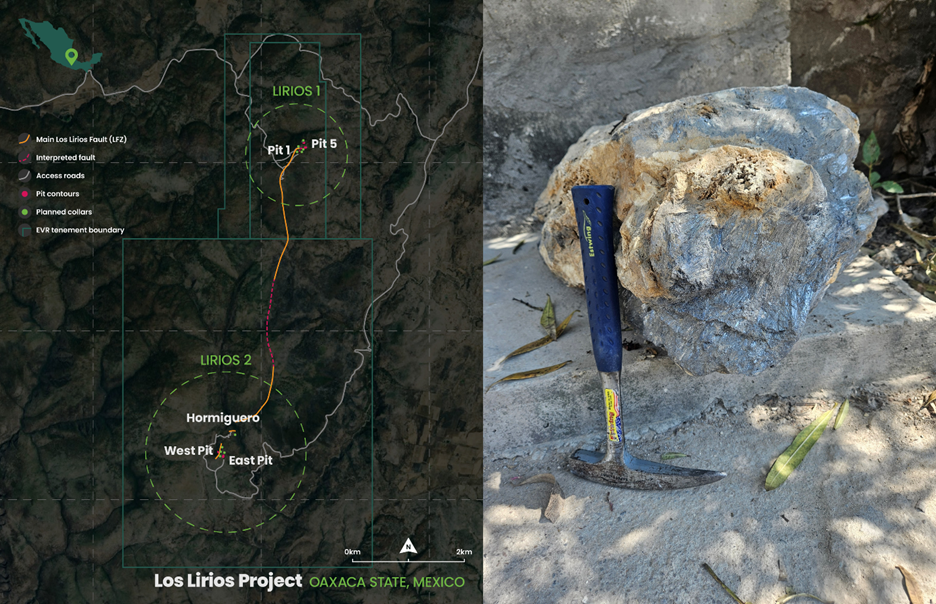
CHANNEL SAMPLING PROGRAM
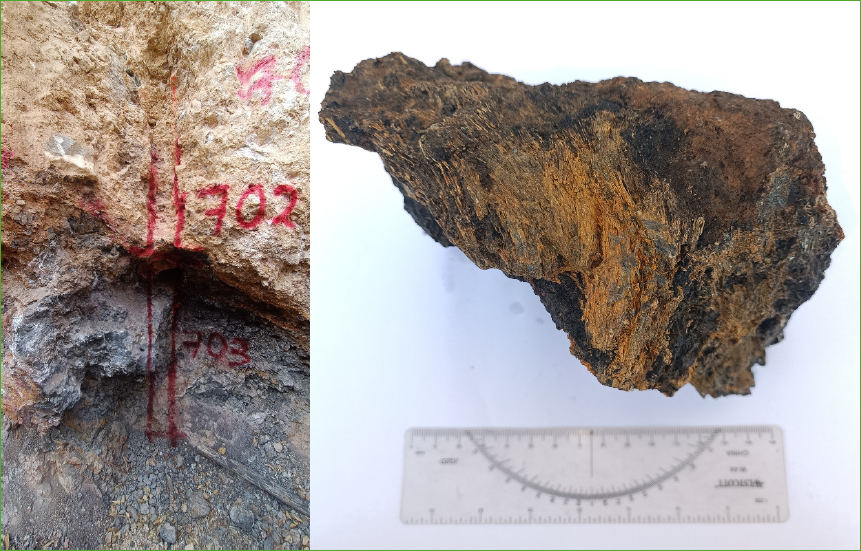
Channel sampling was undertaken at the historical open pits at Lirios 1 and Lirios 2, including one trench at Hormiguero, which has no historical activity. The program was designed to characterise the controls and styles of mineralisation mined previously targeted for high content stibnite for direct shipping ore, which remains visible on exposed historical pit and adit walls.
A total of 129 samples were selected for assaying, focused on high-priority zones to understand the structural and lithological drivers of the system. Based on the visual predominance of stibnite within mineralised zones, the samples were only assayed for antimony.
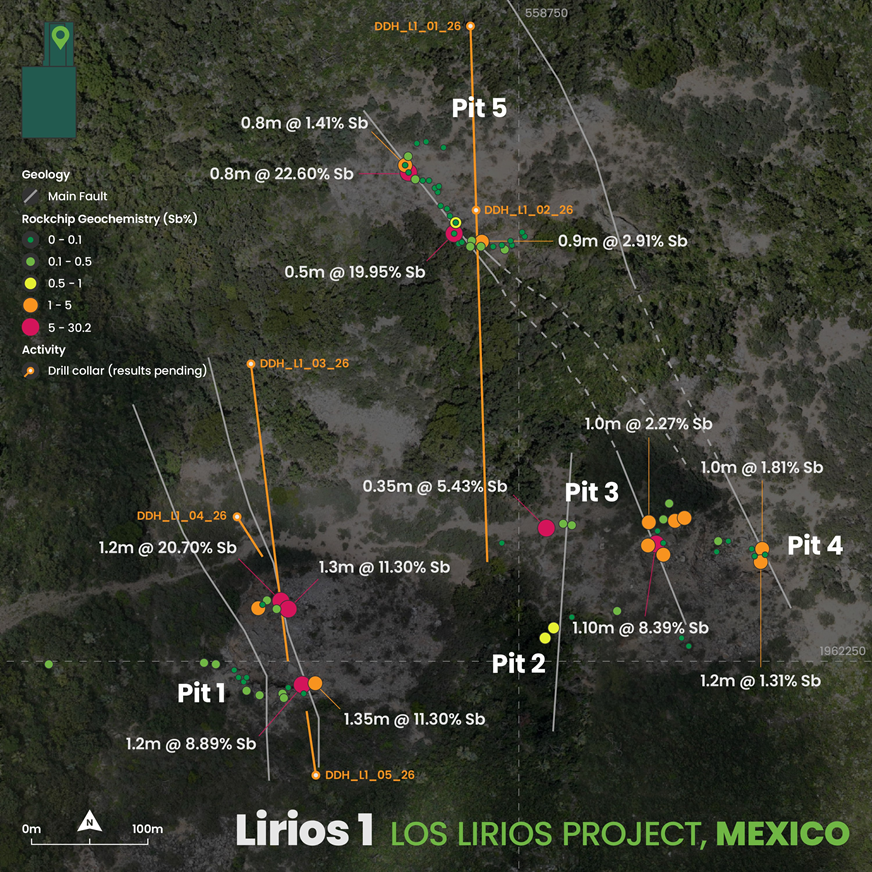
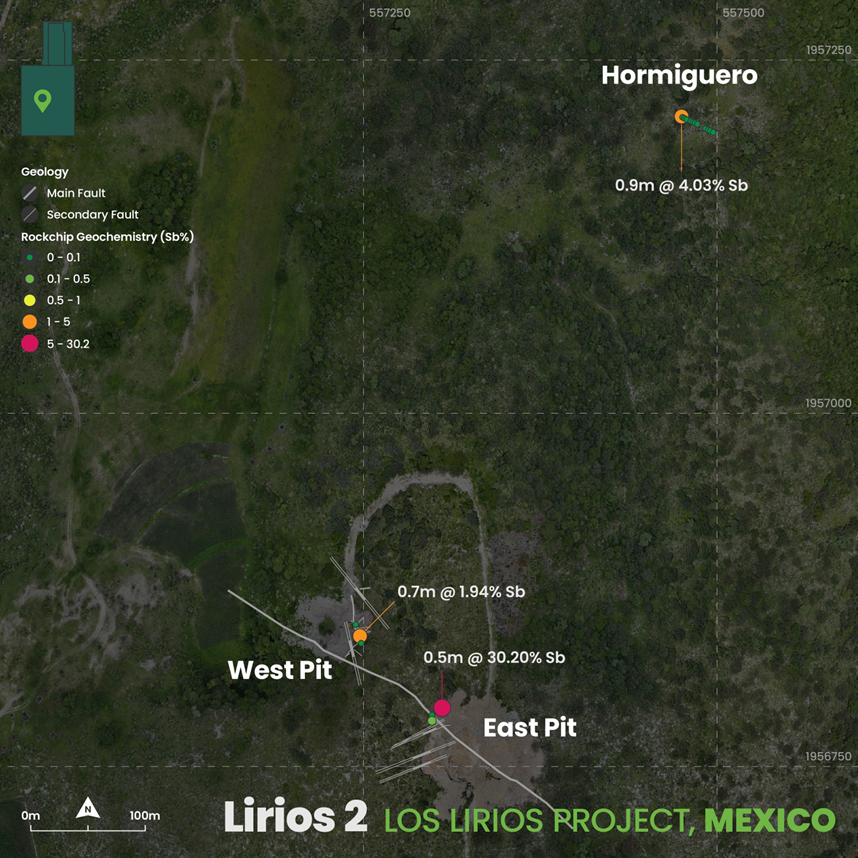
The sampling has established two styles of mineralisation present, which are interpreted as being associated with the same hydrothermal system:
- Fault/conduit related mineralisation: within veinlet systems and open space infill. Style of mineralisation was stibnite±quartz with calcite as the main gangue present. This is accompanied by moderate to strong localised silicification alteration, forming an alteration halo envelope. Near surface weathering of this mineralisation formed oxidised zones with stibiconite±quartz±iron oxides±clays.
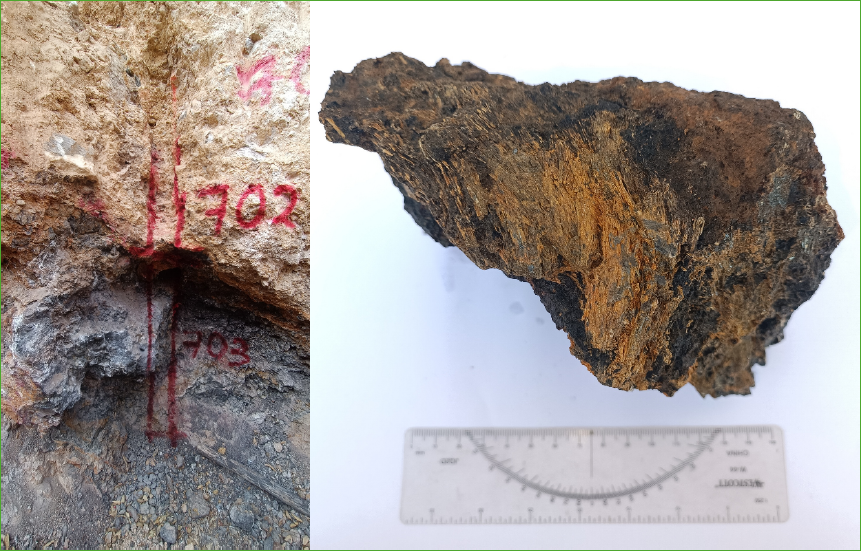
- Replacement mineralisation: characterised by replacement and fracture infill of stibnite±quartz with calcite as the main form within limestone units. In some areas this was also observed in gypsum units, which exhibit more ductile deformation features.
Significant Antimony Results
Table 1: Select Significant Antimony Results
| ID_SAMPLE | Easting | Northing | Elevation | Length (m) | Sb Reportable (%) | CLAIM | AREA |
| 856564 | 558778 | 1962280 | 1723 | 1.00 | 2.27 | LIRIOS 1 | PIT 3 |
| 856703 | 558699 | 1962263 | 1742 | 1.20 | 20.70 | LIRIOS 1 | PIT 1 |
| 856706 | 558701 | 1962261 | 1742 | 1.30 | 11.30 | LIRIOS 1 | PIT 1 |
| 856730 | 558694 | 1962261 | 1743 | 0.40 | 1.08 | LIRIOS 1 | PIT 1 |
| 856743 | 558706 | 1962245 | 1745 | 1.35 | 3.04 | LIRIOS 1 | PIT 1 |
| 856746 | 558704 | 1962245 | 1746 | 1.20 | 8.89 | LIRIOS 1 | PIT 1 |
| 856760 | 558756 | 1962278 | 1730 | 0.35 | 5.43 | LIRIOS 1 | LINDA VISTA/PIT 2 |
| 856785 | 558786 | 1962281 | 1720 | 0.60 | 1.16 | LIRIOS 1 | PIT 3 |
| 856786 | 558783 | 1962280 | 1721 | 0.40 | 2.13 | LIRIOS 1 | PIT 3 |
| 856793 | 558779 | 1962275 | 1724 | 1.10 | 8.29 | LIRIOS 1 | PIT 3 |
| 856794 | 558778 | 1962275 | 1724 | 0.60 | 2.43 | LIRIOS 1 | PIT 3 |
| 856795 | 558780 | 1962273 | 1724 | 0.80 | 1.16 | LIRIOS 1 | PIT 3 |
| 856805 | 558802 | 1962271 | 1718 | 1.20 | 1.31 | LIRIOS 1 | PIT 4 |
| 856806 | 558802 | 1962274 | 1717 | 1.00 | 1.81 | LIRIOS 1 | PIT 4 |
| 856809 | 558726 | 1962355 | 1713 | 0.80 | 22.60 | LIRIOS 1 | PIT 5 |
| 856831 | 558737 | 1962344 | 1714 | 0.80 | 2.79 | LIRIOS 1 | PIT 4 |
| 856834 | 558736 | 1962342 | 1715 | 0.50 | 19.95 | LIRIOS 1 | PIT 5 |
| 856840 | 558742 | 1962340 | 1714 | 0.90 | 2.91 | LIRIOS 1 | PIT 5 |
| 856857 | 558726 | 1962356 | 1712 | 0.80 | 1.41 | LIRIOS 1 | PIT 5 |
| 856667 | 557475 | 1957210 | 1522 | 0.90 | 4.03 | LIRIOS 2 | HORMIGUERO |
| 2CH-10B | 557248 | 1956843 | 1583 | 0.70 | 1.49 | LIRIOS 2 | WEST PIT |
| CH-04B | 557306 | 1956792 | 1586 | 0.50 | 30.20 | LIRIOS 2 | EAST PIT |
GEOLOGICAL FRAMEWORK
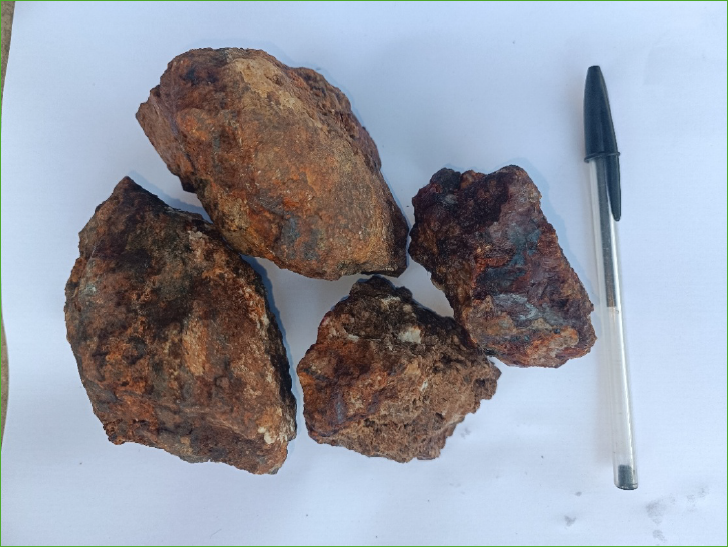
The Lirios Fault Zone (LFZ) is interpretated as being the main structural and fluid conduit on the property. The areas where this dominantly NNE trending system has been cross-cut by west to north-west trending faults has created denser veinlet networks and open space, providing likely ‘bonanza-style’ zones (see Figure 1) for drill targeting. The CRD mineralisation is dominantly within limestone units and is assumed to extend laterally from the main fluid conduits, in particular where open space from veinlet networks and brecciation aided permeability. This is considered by the Company to represent a significant potential target, with mineralisation observed in beds from 1-3m thick (see Figure 4).
ASSAYING DISCUSSION
Due to the highly volatile nature of stibnite, the Company worked with ALS Laboratories to undertake an evaluation of assaying techniques to establish a confident and robust assaying process. This investigation was critical to ensure that the high stibnite content nature of the Los Lirios mineralisation is accurately captured in all reporting.
First pass assaying utilised agua regia digestion, which only reports the leachable portion of antimony mineralisation. Results reported at the overlimit (>10,000ppm) were subsequently subjected to four acid digestion which, despite it being an industry standard approach, can cause issues with volatilisation of the stibnite due to chloride ions in hydrochloric acid. This resulted in underreporting with five overlimit results returning less than 1% Sb. This confirmed standard digestion processes aren’t fully suited for material with high content of stibnite, such as that at Lirios.
To resolve these discrepancies, the Company used Sb_ICP08 method, which utilises digestion with hydrochloric acid and potassium chlorate with tartaric acid as a stabilising agent prior to measurement. This also showed significant vairiability outside of acceptable ranges. Subsequently, oxidising fusion in a lithium borate flux, followed by XRF with a short fusion time (XRF10) was used, however, this failed to fuse the sample.
ALS used a longer fusion time (XRF15c), which proved highly effective, providing the most stable and accurate data for handling the presence of stibnite associated with quartz. Figure 6 details the variability observed between assay methods, highlighting the importance of conducting the investigation. As such, the Company has established a reporting hierarchy of XRF15 > Sb_ICP08 > Sb_OG62 > ME_ICP41.
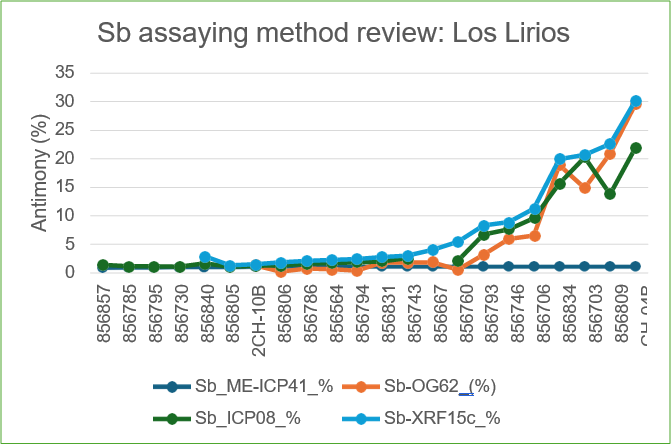
Additionally, Table 2 illustrates that samples below overlimit (<1% Sb) showed significant discrepancies across different analytical techniques. These variances confirm that under-reporting bias is not restricted to material with high (overlimit) stibnite content. To address this, the Company will now adopt automatic overlimit testing protocols for all samples >5000 ppm Sb (0.5% Sb), ensuring they are assayed using the more definitive XRF fusion method.
Table 2: Comparative overlimit assaying results by method
| ID_SAMPLE | Sb_ME-ICP41_% | Sb-OG62_(%) | Sb_ICP08_% | Sb-XRF15c_% |
| 856857 | 0.804 | 1.41 | ||
| 856785 | 0.855 | 1.16 | ||
| 856795 | 0.866 | 1.16 | ||
| 856730 | 0.873 | 1.08 | ||
| 856840 | 0.882 | 1.64 | 2.91 | |
| 856805 | 0.953 | 1.08 | 1.31 | |
| 2CH-10B | >1 | 1.35 | 1.26 | 1.49 |
| 856806 | >1 | 0.23 | 1.30 | 1.81 |
| 856786 | >1 | 0.73 | 1.58 | 2.13 |
| 856564 | >1 | 0.66 | 1.78 | 2.27 |
| 856794 | >1 | 0.37 | 1.86 | 2.43 |
| 856831 | >1 | 1.80 | 2.02 | 2.79 |
| 856743 | >1 | 1.84 | 2.56 | 3.04 |
| 856667 | >1 | 1.88 | 4.03 | |
| 856760 | >1 | 0.59 | 2.17 | 5.43 |
| 856793 | >1 | 3.15 | 6.73 | 8.29 |
| 856746 | >1 | 5.95 | 7.66 | 8.89 |
| 856706 | >1 | 6.51 | 9.59 | 11.3 |
| 856834 | >1 | 18.90 | 15.65 | 19.95 |
| 856703 | >1 | 14.90 | 20.30 | 20.7 |
| 856809 | >1 | 20.90 | 13.80 | 22.6 |
| CH-04B | >1 | 29.60 | 21.90 | 30.2 |
STRATEGIC SIGNIFICANCE
The results validate the Company’s high confidence and confirm the project represents a significant antimony enriched hydrothermal system. The grade and widespread distribution of antimony validates further exploration along the 6km feeder fault, with present drilling focussing on just 900m of this system.
With strong community relations, established infrastructure and an experienced local team, EVR is well positioned to advance activities aimed at discovery and establishing a JORC maiden resource estimate in 2026.
NEXT STEPS
- Receipt of preliminary direct to smelter metallurgical results
- Finalisation of preliminary engineering and budget for Tecomatlán Plant and commencement of Phase 1 refurbishment
- Commence soil sampling programs at Nevada projects
- Drill Assays: First results from the Lirios 1 diamond drilling campaign are expected in 4-8 weeks.
- US Government Agencies: Commence strategic review to establish a roadmap with advisor for relevant programs and engagement strategy and plan.
– ENDS –
For further information, please contact:
Mike Brown
Managing Director & CEO
Tel: +61 466 856 061
E: [email protected]
This ASX announcement was authorised for release by the Board of EV Resources Limited.
About EV Resources
EV Resources (ASX: EVR) is a critical minerals exploration and development company focused on securing the North American antimony supply chain.
We are rapidly transitioning from a diversified explorer to a near-term producer. Our strategy is centered on antimony, a critical mineral designated by the US, EU, and Australia as essential for energy storage, battery technology, defence, and high-tech applications.
Our asset portfolio is strategically positioned in mining-friendly jurisdictions:
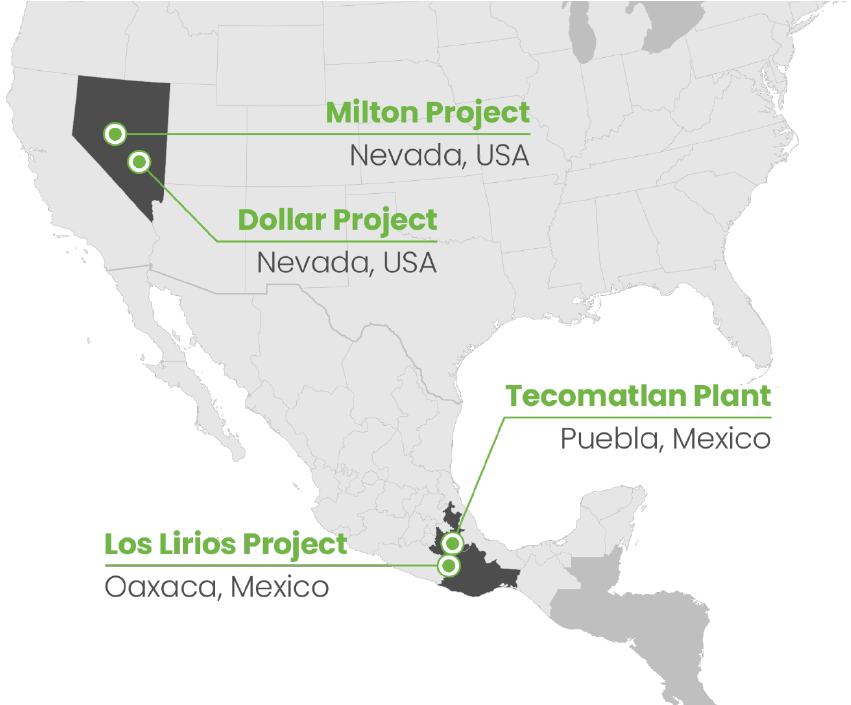
- Los Lirios Antimony Project (Mexico): Our flagship, high-grade project. We are fast-tracking Los Lirios to production, a goal supported by our acquisition of the nearby Tecomatlán Processing Plant, which provides a low-capex path to cash flow.
- US Antimony Projects (Nevada): We hold a 100% interest in the Dollar and Milton Canyon antimony projects, key assets in our strategy to build a secure, domestic critical minerals supply chain for the United States.
Competent Person Statement
The information in this release that relates to Metallurgical Results is based on information compiled by Mr Mike Brown who is a Member of the Australian Institute of Geoscientists (MAIG). Mr Brown is Managing Director and CEO of EVR. Mr Brown has sufficient experience which is relevant to the style of mineralisation and type of deposit under consideration and to the activity which he is undertaking to qualify as a Competent Person as defined in the 2012 Edition of the “Australasian Code for Reporting of Exploration Results, Mineral Resources and Ore Reserves”. Mr Brown consents to the inclusion in this announcement of the matters based on information in the form and context in which it appears.
Forward Looking Statement
Forward Looking Statements regarding EVR´s plans with respect to its mineral properties and programs are statements that are not historical facts. Words such as “expect(s)”, “feel(s)”, “believe(s)”, “will”, “may”, “anticipate(s)”, “potential(s)”and similar expressions are intended to identify forward-looking statements. These statements include, but are not limited to statements regarding future production, resources or reserves and exploration results. All of such statements are subject to certain risks and uncertainties, many of which are difficult to predict and generally beyond the control of the company, that could cause actual results to differ materially from those expressed in, or implied or projected by, the forward-looking information and statements. There can be no assurance that EVR’s plans for development of its mineral properties will proceed as currently expected. There can also be no assurance that EVR will be able to confirm the presence of additional mineral resources, that any mineralisation will prove to be economic or that a mine will successfully be developed on any of EVR’s mineral properties. The performance of EVR may be influenced by a number of factors which are outside the control of the Company and its Directors, staff, and contractors.
These risks and uncertainties include, but are not limited to: (i) those relating to the interpretation of drill results, the geology, grade and continuity of mineral deposits and conclusions of economic evaluations, (ii) risks relating to possible variations in reserves, grade, planned mining dilution and ore loss, or recovery rates and changes in project parameters as plans continue to be refined, (iii) the potential for delays in exploration or development activities or the completion of feasibility studies, (iv) risks related to commodity price and foreign exchange rate fluctuations, (v) risks related to failure to obtain adequate financing on a timely basis and on acceptable terms or delays in obtaining governmental approvals or in the completion of development or construction activities, and (vi) other risks and uncertainties related to the company’s prospects, properties and business strategy. Our audience is cautioned not to place undue reliance on these forward-looking statements that speak only as of the date hereof, and we do not undertake any obligation to revise and disseminate forward-looking statements to reflect events or circumstances after the date hereof, or to reflect the occurrence of or non-occurrence of any events.
Original Article: https://api.investi.com.au/api/announcements/evr/fb9eb919-205.pdf