Testing of a second regional third-party ore source returned excellent recoveries using conventional flotation and gravity processing. The results further support the Company’s Tecomatlán’s flexible processing-hub strategy.
Highlights
- Up to 78.6% Antimony Recovery: Initial bulk flotation testwork on Vinatas material achieved 78.6% cumulative Sb recovery and produced a flotation concentrate grading of 58.82% Sb using a conventional PAX and lead nitrate reagent scheme.
- Strong Results Repeated: Follow-up flotation testing achieved 75.8% Sb recovery under similar grinding and reagent conditions, providing encouraging preliminary evidence of repeatable metallurgical performance.
- High Grade 68.3% Sb Concentrate Produced: Gravity upgrading of the Test 2 flotation concentrate using a Wilfley shaking table produced a high-grade stibnite concentrate grading of 68.3% Sb with only 4.36% SiO₂, demonstrating effective silica rejection and concentrate upgrading.
- Additional Recovery Potential from Tailings: Falcon centrifugal concentration successfully recovered additional very fine-grained stibnite (200 mesh) remaining in the flotation tailings, demonstrating potential to further improve overall recovery and reduce antimony losses to final tailings.
- Preliminary Preferred Processing Route Identified: Testwork supports a preliminary processing route incorporating grinding, conventional bulk flotation, gravity cleaning of flotation concentrates and centrifugal recovery of residual antimony from flotation tailings.
- Direct Fit with Tecomatlán: The Vinatas processing route utilises conventional flotation and gravity technologies directly aligned with the processing circuits installed at the Tecomatlán Processing Plant, further demonstrating the value of the Plant’s flexible processing configuration.
- Second Regional Feedstock Source Demonstrates Excellent Metallurgy: Together with the previously reported Chinantla metallurgical results, Vinatas provides a second regional third-party ore source to demonstrate excellent metallurgical response to conventional processing technologies compatible with Tecomatlán.
- Potential Third-Party Supply Pathway: Vinatas is included under the third-party antimony supply Memorandum of Understanding signed in May 2026. Based on the positive
EV Resources (“EVR” or the “Company”) is pleased to report positive preliminary metallurgical results from material sourced from the Vinatas antimony operation in Mexico, a third-party ore source included under the Company’s third-party antimony supply Memorandum of Understanding (“MOU”) signed in May 2026.
The results materially advance the technical evaluation of Vinatas as a third-party feed source for the Tecomatlán Processing Plant and provide further support for EVR’s strategy to establish Tecomatlán as a flexible regional antimony processing hub. Importantly, Vinatas represents the second regional third-party ore source, following Chinantla, to demonstrate strong metallurgical response to conventional processing technologies compatible with the gravity and flotation configuration at Tecomatlán.
The test program, completed by independent laboratory Metalurgia y Equipos (“ME”) and supervised by engineer Armando G. Aguilar, evaluated bulk flotation, controlled grinding, gravity cleaning of flotation concentrate and centrifugal recovery of very fine-grained stibnite from flotation tailings. A detailed report of the test program methodology and results has been submitted to the Company and the results reported in this announcement are consistent with those reported by ME.
The testwork demonstrates that the Vinatas material tested is amenable to conventional mineral processing technologies and has identified a preliminary processing route capable of producing a high-grade stibnite concentrate.
EV Resources Interim CEO, Miguel Barahona, commented:
“These results are another important step in building the Tecomatlán regional processing model. Vinatas is now the second regional third-party feed source, alongside Chinantla, to demonstrate strong metallurgical performance using conventional processing technologies compatible with Tecomatlán.
Achieving flotation recoveries of up to 78.6%, together with the production of a High Grade 68.3% Sb concentrate through subsequent gravity upgrading, is highly encouraging.
Just as importantly, the results demonstrate why we have developed Tecomatlán with a flexible combination of flotation and gravity processing. Different regional ore sources may require different combinations of these circuits, giving us the ability to adapt the processing route to the characteristics of the feed.
We are continuing to build regional feedstock around Tecomatlán while progressing the Plant toward Proof-of-Concept operations and the production of a marketable antimony concentrate.”
Metallurgical Results
The test program evaluated a combination of bulk flotation, controlled grinding, gravity concentration and centrifugal recovery techniques to establish a practical preliminary processing route for Vinatas material.
The strongest direct flotation performance was achieved using a conventional reagent scheme incorporating potassium amyl xanthate (PAX) and lead nitrate.
Strong Flotation Response Confirmed
The first bulk flotation test of stibnite ore was conducted on material with a calculated head grade of 13.8% Sb and 45.4% SiO₂. Following grinding to 87% passing 200 mesh, the flotation circuit produced a concentrate grading of 58.82% Sb and achieved cumulative antimony recovery of 78.6%.
A second test on material with a calculated head grade of 12.0% Sb produced a combined bulk flotation concentrate grading of 47.4% Sb at 75.8% Sb recovery under similar grinding conditions.
The comparable recoveries achieved in Tests 1 and 2 provide encouraging preliminary evidence of the repeatability of the response of the Vinatas material tested to conventional flotation using a PAX collector activated with lead nitrate (Figure 1).
High Grade Stibnite Concentrate Produced
Further upgrading of the Test 2 bulk flotation concentrate through gravity cleaning on a Wilfley shaking table produced a stibnite concentrate grading of 68.3% Sb with only 4.36% SiO₂.
This represents a significant upgrade from the 47.4% Sb bulk flotation concentrate and demonstrates the effectiveness of gravity concentration for upgrading the flotation concentrate produced from the Vinatas material tested.
The shaking-table tailings graded 38.0% Sb, indicating the potential for recirculation or further treatment as part of an optimised integrated flowsheet.
The results demonstrate the potential to produce a >65% Sb stibnite concentrate through a combination of conventional flotation and gravity concentration.
Additional Recovery Potential from Tailings
The program also investigated opportunities to recover stibnite remaining in flotation tailings.
Three sequential passes of the tailings through a Falcon centrifugal concentrator recovered additional stibnite into secondary gravity concentrates and reduced the final tailings grade from 6.14% Sb to 2.17% Sb (Table 1).
These results demonstrate the potential for a gravity recovery stage on flotation tailings to increase overall stibnite recovery while reducing metal losses to final tailings.
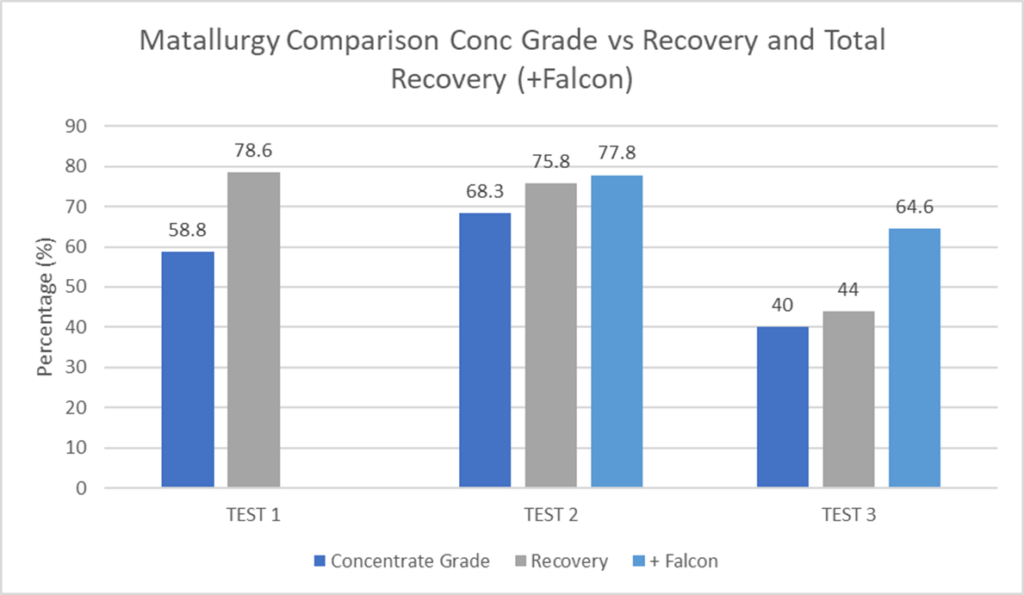
Table 1: Summary of Vinatas Metallurgical Test Results
| Variable / Parameter | Test 1 | Test 2 | Test 3 |
| Grinding (−200 mesh) | 26 min (87%) | 26 min (87%) | 30 min (90%) |
| Main reagent scheme | PAX + Pb(NO₃)₂ | PAX + Pb(NO₃)₂ | PAX + Aerophine 3418A + Pb(NO₃)₂ |
| Calculated head grade (Sb / SiO₂) | 13.8% / 45.4% | 12.0% / 47.9% | 13.4% / 48.0% |
| Flotation concentrate grade | 58.82% Sb | 47.4% Sb | 40.0% Sb |
| Cumulative flotation recovery | 78.6% Sb | 75.8% Sb | 44.0% Sb |
| Flotation tailings grade | 3.9% Sb | 3.6% Sb | 6.1% Sb |
| Secondary gravity stage | Not applied | Table conc.: 68.3% Sb; Falcon tailings conc.: 7.5% Sb | 3-stage Falcon on tailings: reduced from 6.14% to 2.17% Sb |
Note: results are preliminary, laboratory bench-scale metallurgical test results only and are not a substitute for larger-scale or continuous process validation. Test 3 evaluated an alternative collector (Aerophine 3418A) at finer grind, which reduced direct flotation performance; the preferred flowsheet is based on the Test 2 conditions. Use of a Falcon concentrator enhanced recovery of very fine-grained stibnite and significantly reduced the Sb grade in tailings.
Preliminary Preferred Processing Route Identified
Based on the results obtained to date, the metallurgical work has identified a preliminary preferred processing route for the Vinatas material tested comprising:
- grinding to approximately 87% passing 200 mesh;
- conventional bulk flotation using the Test 2 reagent scheme;
- gravity cleaning of the flotation concentrates to produce a high-grade final concentrate; and
- centrifugal concentration of flotation tailings to recover very fine grained stibnite.
Importantly, the results demonstrate the value of Tecomatlán’s flexible processing configuration. Different regional feedstocks may utilise the Plant’s flotation and gravity circuits in different combinations according to their individual mineralogical and metallurgical characteristics.
This flexibility is demonstrated by the differing preliminary processing routes identified for Vinatas and Chinantla, while both utilise conventional processing technologies compatible with the Tecomatlán Plant.
Further confirmatory and optimisation testwork may be undertaken under the recommended operating conditions to validate concentrate grade, overall recovery and recirculation of intermediate products prior to larger-scale processing.
Vinatas Supply Opportunity
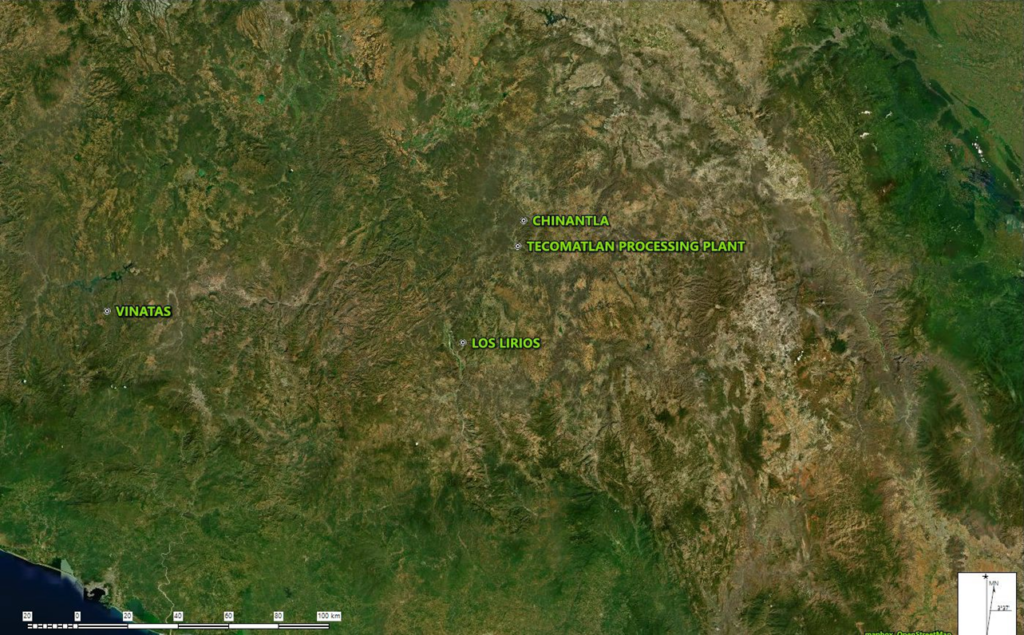
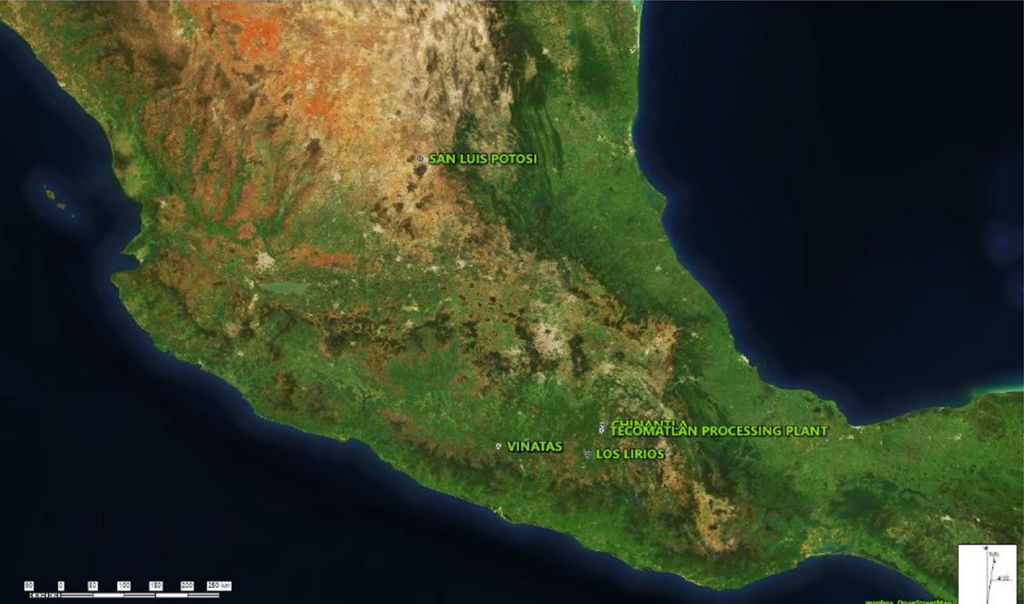
Vinatas is included under EVR’s existing MOU relating to potential third-party antimony ore supply arrangements, signed in May 2026. The operation has an established history of antimony production and sales. Vinatas has previously sold run-of-mine (ROM) antimony ore to a processing facility in San Luis Potosí, located approximately 500km (straight line) from the mine site. The Tecomatlán Processing Plant, located approximately 170km (straight line) from Vinatas, represents a significantly closer potential processing destination, providing an opportunity to reduce transportation requirements and improve overall logistics.
Vinatas has advised that they are able to supply approximately 80 tonnes per month of material, with the ability to supply either lower-grade mineralised material (approximately 5–29.9% Sb) or higher-grade direct-shipping ore (>30% Sb), depending on market conditions and mining schedules. Material could initially be supplied as-mined, without requiring significant upfront processing infrastructure at the mine site. The current production scenario is viewed as an initial starting point and may have expansion potential through additional mine development, underground preparation and improved access to mineralised zones.
Any future ore supply to Tecomatlán would be expected to commence following completion and commissioning of the processing plant, aligning mine production with plant start-up. No binding supply agreement has yet been finalised, and discussions remain ongoing.
Direct Fit with Tecomatlán’s Flexible Processing Configuration
The Tecomatlán Processing Plant has been configured to incorporate both gravity concentration and flotation circuits, providing EVR with flexibility to treat different regional feedstocks according to their individual mineralogical and metallurgical characteristics.
The preliminary Vinatas processing route — conventional flotation combined with gravity concentration — is directly aligned with this configuration.
Importantly, the Vinatas results follow the previously reported Chinantla testwork, which achieved 81.1% antimony recovery through bulk flotation and demonstrated the ability to produce a stibnite concentrate grading up to 62.9% Sb through subsequent upgrading testwork.1
Vinatas has now independently demonstrated flotation recovery of up to 78.6%, together with the production of a High Grade 68.3% stibnite concentrate.
While the preliminary preferred processing routes for the two ore sources differ in the way flotation and gravity are combined, both utilise conventional processing technologies compatible with the Tecomatlán configuration.
The results therefore provide further technical support for EVR’s strategy of establishing Tecomatlán as a flexible regional processing hub designed to receive and process antimony-bearing material from multiple regional sources.
The addition of potential Vinatas feed alongside the arrangements being progressed at Chinantla would increase the diversity of potential third-party processing inventory available to Tecomatlán and support EVR’s objective of maximising utilisation of its existing processing infrastructure.
Forward Plan and Next Steps
- Review results with the project owners and evaluate opportunities for confirmatory metallurgical testing under the preferred operating conditions and integrated flowsheet, to further validate concentrate grade, overall recovery and operating parameters.
- Evaluate potential expanded future supply discussions, which may include advancing toward a binding ore supply agreement, like the arrangement being pursued for Chinantla, with any supply expected to commence following completion and commissioning of the Tecomatlán plant.
- Continue Tecomatlán plant integration toward Proof-of-Concept operations, targeting production of a marketable antimony concentrate from regional third-party ore.
- Evaluate optimisation opportunities including treatment and recirculation of intermediate products and flotation tailings to further improve overall antimony recovery.
Cautionary Statement
The metallurgical results reported in this announcement are preliminary, laboratory bench-scale results completed on samples of mineralised material provided from the Vinatas operation and are not a guarantee of the metallurgical performance of future ore deliveries or of plant-scale operations. Vinatas is a third-party operation in which EVR holds no ownership interest, and no Mineral Resource or Ore Reserve has been estimated by EVR in respect of Vinatas. The MOU referred to in this announcement is non-binding, and there is no certainty that a binding ore supply agreement will be executed or as to the final terms of any such agreement. Any ore supply is subject to, among other things, completion and commissioning of the Tecomatlán processing plant
1 ASX Announcement dated 24 June 2026 – Flotation Test Work Delivers 81% Antimony Recovery
Competent Person Statement
The information in this report that relates to the Metallurgical Results is based on information reviewed by Mr Michael C Corey, who is a Member of the Association of Professional Geoscientists of Ontario, Canada. Michael Corey is an independent consultant and has sufficient experience which is relevant to the style of mineralisation and type of deposit under consideration and to the activity which he is undertaking to qualify as a Competent Person as defined in the 2012 Edition of the ‘Australasian Code for Reporting of Exploration Results, Mineral Resources and Ore Reserves’. Mr Corey consents to the inclusion in this announcement of the matters based on the results in the form and context in which they appear.
Compliance Statement
This announcement contains metallurgical results extracted from ASX market announcement dated 24 June 2026 and reported in accordance with the 2012 edition of the “Australasian Code for Reporting of Exploration Results, Mineral Resources and Ore Reserves” (“2012 JORC Code”). EVR confirms that it is not aware of any new information or data that materially affects the information included in the original ASX market announcement. The Company confirms that the form and context in which the Competent Person’s findings are presented have not been materially modified from the original market announcement.
– ENDS –
This announcement was authorised for release by the Board of EV Resources Ltd.
For further information, please contact:
Shane Menere
Executive Chairman
Tel: +61 8 6489 0600
E: [email protected]
Forward Looking Statement
Forward Looking Statements regarding EVR´s plans with respect to its mineral properties and programs are statements that are not historical facts. Words such as “expect(s)”, “feel(s)”, “believe(s)”, “will”, “may”, “anticipate(s)”, “potential(s)” and similar expressions are intended to identify forward-looking statements. These statements include, but are not limited to statements regarding future production, resources or reserves and exploration results. All of such statements are subject to certain risks and uncertainties, many of which are difficult to predict and generally beyond the control of the company, that could cause actual results to differ materially from those expressed in, or implied or projected by, the forward-looking information and statements. There can be no assurance that EVR’s plans for development of its mineral properties will proceed as currently expected. There can also be no assurance that EVR will be able to confirm the presence of additional mineral resources, that any mineralisation will prove to be economic or that a mine will successfully be developed on any of EVR’s mineral properties. The performance of EVR may be influenced by a number of factors which are outside the control of the Company and its Directors, staff, and contractors.
These risks and uncertainties include, but are not limited to: (i) those relating to the interpretation of drill results, the geology, grade and continuity of mineral deposits and conclusions of economic evaluations, (ii) risks relating to possible variations in reserves, grade, planned mining dilution and ore loss, or recovery rates and changes in project parameters as plans continue to be refined, (iii) the potential for delays in exploration or development activities or the completion of feasibility studies, (iv) risks related to commodity price and foreign exchange rate fluctuations, (v) risks related to failure to obtain adequate financing on a timely basis and on acceptable terms or delays in obtaining governmental approvals or in the completion of development or construction activities, and (vi) other risks and uncertainties related to the company’s prospects, properties and business strategy. Our audience is cautioned not to place undue reliance on these forward-looking statements that speak only as of the date hereof, and we do not undertake any obligation to revise and disseminate forward-looking statements to reflect events or circumstances after the date hereof, or to reflect the occurrence of or non-occurrence of any events.
About EV Resources
EV Resources (ASX: EVR) is a critical minerals exploration and development company focused on securing the North American antimony supply chain.
We are rapidly transitioning from a diversified explorer to an expected near-term antimony producer. Antimony is a designated critical mineral by the US, EU, and Australia, with applications in energy storage, battery technology, defence, and high-tech applications.
Our asset portfolio is strategically positioned in mining-friendly jurisdictions:
Tecomatlán Processing Plant (Mexico): EVR’s regional antimony processing hub and centrepiece of its near-term Proof-of-Concept strategy. EVR is completing plant integration while establishing regional third-party ore supply, targeting the production of a marketable antimony concentrate and demonstrating the Tecomatlán processing model.
Los Lirios Antimony Project (Mexico): EVR’s high-grade antimony project located approximately 50km from Tecomatlán. Work is progressing towards a maiden JORC Mineral Resource, with Los Lirios being advanced in parallel as a potential future proprietary feed source complementing EVR’s regional third-party ore supply.
US Antimony Projects – Dollar and Milton (Nevada): EVR’s 100%-owned US antimony assets provide direct exposure to the US critical minerals supply chain and complement the Company’s Mexican processing and feedstock strategy as it builds an integrated North American antimony platform.
Integrated North American Antimony Strategy
EVR is building an integrated North American antimony value chain, combining regional ore supply and processing at Tecomatlán, potential future proprietary feed from Los Lirios and direct US exposure through its Nevada assets. EVR is funded through its planned Proof-of-Concept phase and is targeting production of a marketable antimony concentrate. Beyond Proof-of-Concept, the Company intends to pursue select strategic and offtake partnerships to accelerate its objective of supplying antimony into the Noth American market.
Source: EV Resources Limited
Original Press Release: https://api.investi.com.au/api/announcements/evr/aff60c74-12e.pdf