31 channel samples submitted for assaying across four newly identified target areas, materially expanding the drill-ready target inventory at Los Lirios
Highlights
- Four New Feeder Vein Systems Confirmed – Resource Expansion Potential at Los Lirios 1: Mapping has confirmed four previously unrecognised mineralised vein systems at Los Lirios 1, each vein system is interpreted as a hydrothermal feeder to the carbonate replacement (CRD) bodies hosting antimony mineralisation, pointing to potential for a large-scale extension of the mineralised footprint well beyond the area previously drilled (See expansion below in Figure 1):
- Santo Niño Vein
- San Juan Vein
- San Ramón Vein
- JIU Vein
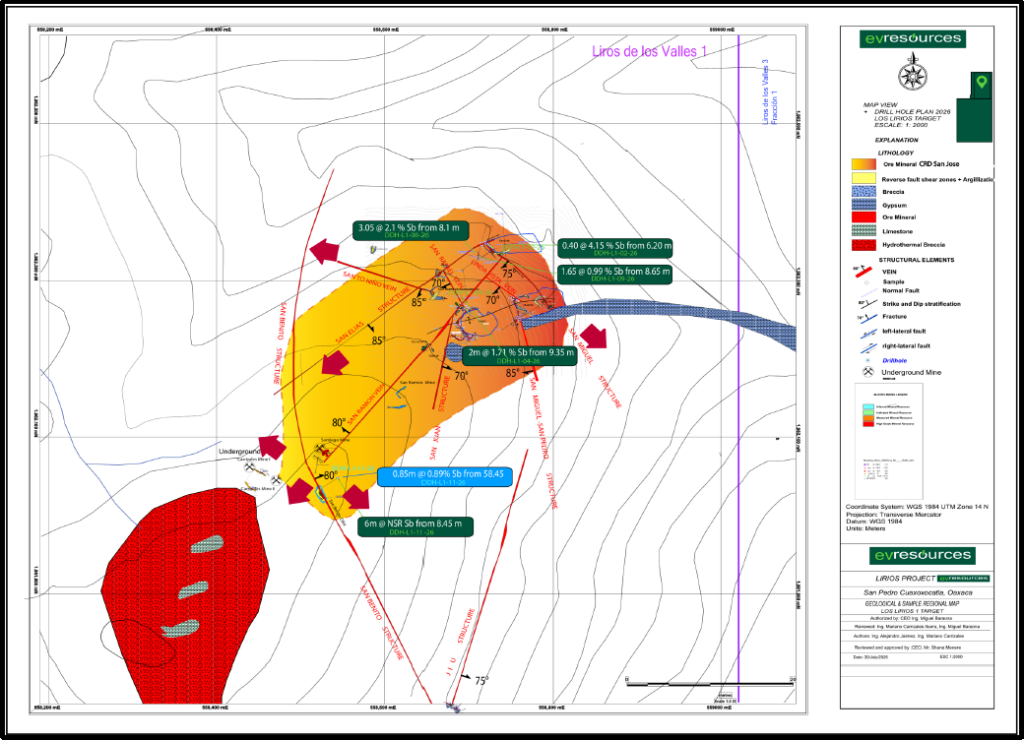
- 900m x 200m Corridor Defined: Mapping has confirmed continuity of the San Benito–Cofradía corridor over approx. 900m of strike and 200m in width, within which multiple replacement bodies, breccias and feeder structures have now been recognised.
- Four New Hydrothermal Breccia Targets: A systematic mapping and reconnaissance program across six priority areas has also identified four new hydrothermal breccia targets, significantly increasing the number of drill-ready targets at Los Lirios.
- 31 Samples Submitted for Analysis: 21 reconnaissance channel samples and 10 systematic channel samples (799001 – 799010) from newly documented underground workings collected for assay, results expected in coming weeks.
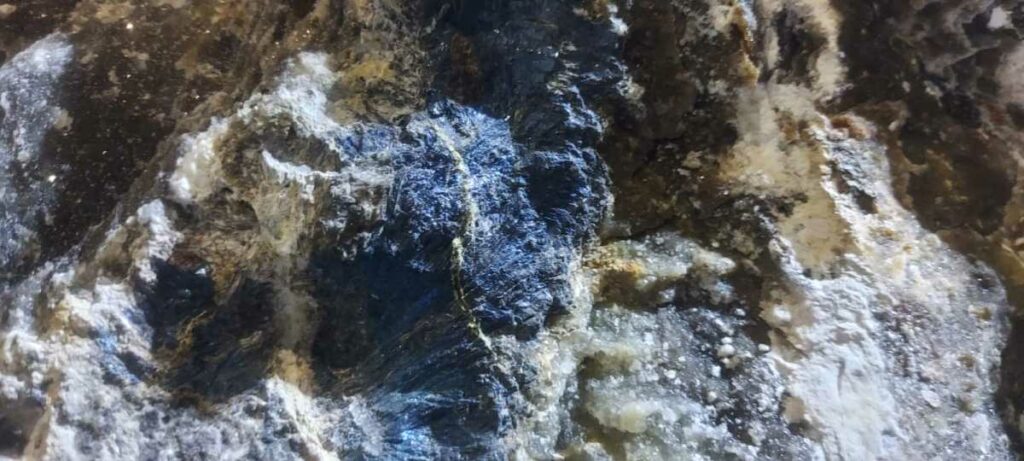
- Coarse Stibnite Observed at Tetlate: Tetlate Shaft 3 exposes coarse stibnite crystals infilling interclast spaces within hydrothermal breccia, alongside barite, cervantite and trace valentinite, the strongest visual mineralisation observed during the campaign.
- Geophysical Coincidence Strengthens Santiago: The Santiago target coincides with a previously defined geophysical anomaly, supporting the interpretation of a hydrothermal conduit that may persist at depth.
- Drilling Pathway Advancing: Environmental authorisation for the second phase of drilling has been confirmed, with a phased diamond drilling program now being designed to test the interpreted breccia pipes and feeder-CRD intersections.
EV Resources (“EVR” or the “Company”) is pleased to provide an update on exploration activities at its 70%-owned Los Lirios Antimony Project in Oaxaca, Mexico. A systematic geological reconnaissance and mapping program has expanded the Company’s target inventory well beyond the areas currently being drilled, with 31 channel samples now submitted for analysis.
The work was designed to identify additional mineralised exposures within existing underground workings and open pits that may contribute to future Mineral Resource growth. It has delivered four previously unrecognised feeder veins, four new hydrothermal breccia targets and a defined 900 m × 200 m mineralised corridor, materially strengthening the geological framework underpinning EVR’s path to a maiden JORC Mineral Resource at Los Lirios.
EV Resources Interim CEO, Miguel Barahona, commented: “Every time our team walks this ground, the system gets bigger. In a single campaign we have gone from one mineralised corridor to four new breccia targets and four new feeder veins, and at Tetlate we are observing sizeable stibnite crystals sitting in the breccia. These are the types of geological features we are looking for as evidence of hydrothermal pathways responsible for antimony mineralisation. Thirty-one samples are now with the laboratory, and those results will tell us where the drill rig goes next as we build toward a maiden Resource at Los Lirios.”
Systematic Mapping Across Six Priority Areas
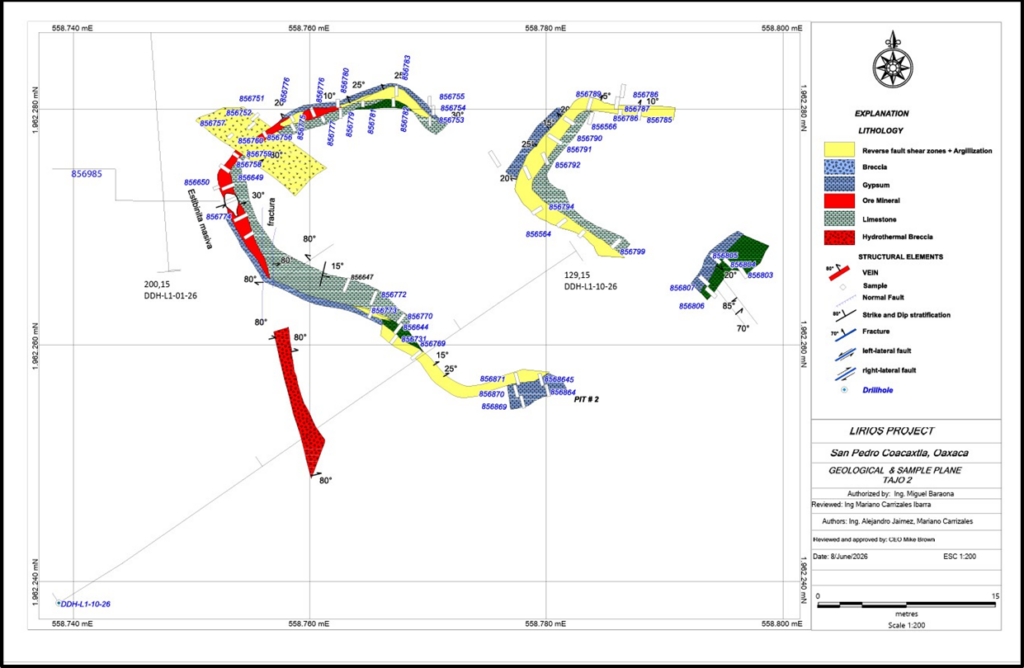
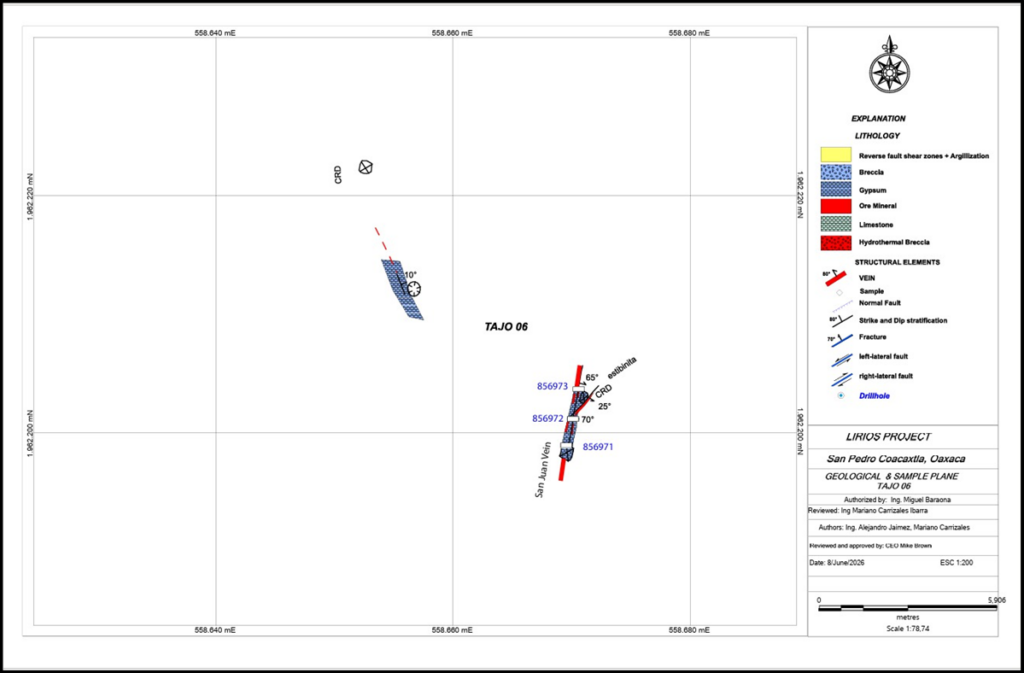
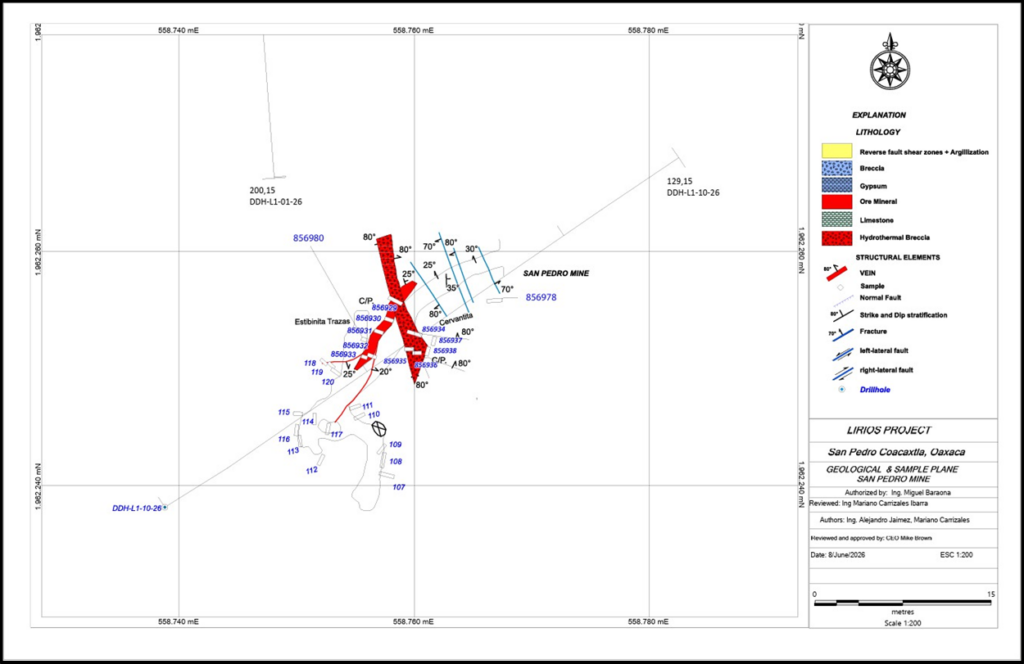
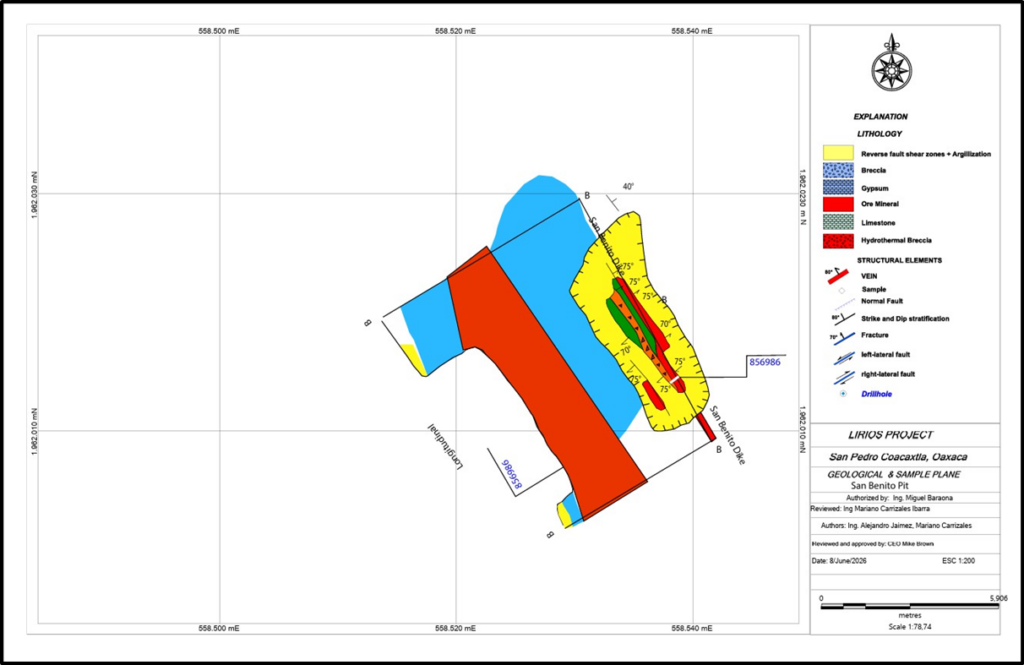
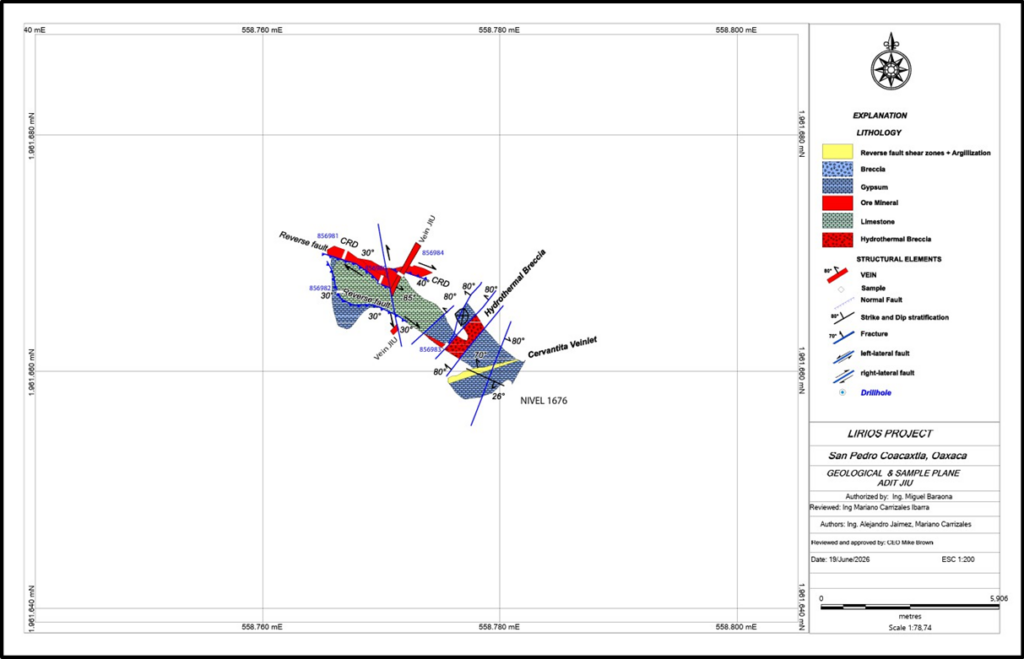
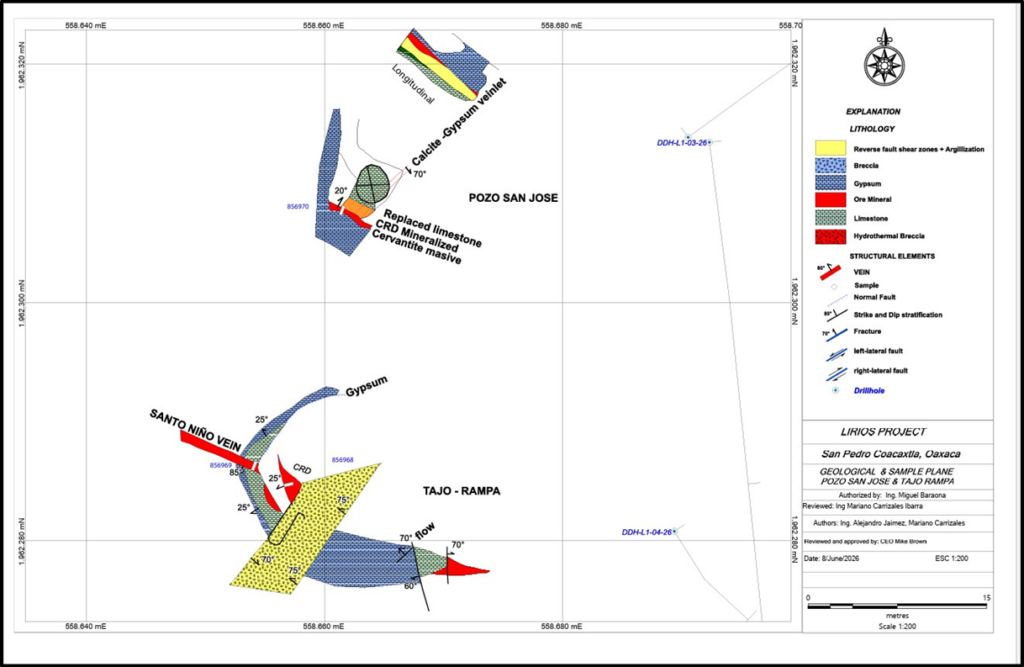
Detailed geological mapping, underground inspections and channel sampling were completed across Los Lirios 1 Open Pit, Pit 6, the San Benito Dyke, Crucero JIU, the Upper Fold Hinge and the Cofradía Area. See Appendix A for Sampling and Geological Map Figures.
Twenty-one (21) channel samples were collected from exposed mineralised zones to validate geological continuity and improve understanding of the structural controls. Field observations support an interpretation in which antimony mineralisation is controlled by a combination of carbonate replacement (CRD) horizons, hydrothermal feeder veins, structural intersections, hydrothermal breccias and silicified regional fault and dyke systems.
Four previously unrecognised mineralised structures were confirmed, the Santo Niño, San Juan, San Ramón and JIU veins. These are interpreted as hydrothermal feeder systems responsible for the development of medium- to high-grade antimony mineralisation within carbonate replacement bodies and are considered highly prospective because they provide direct evidence of the fluid pathways that generate replacement-style mineralisation in favourable carbonate host rocks.
Carrizales and Santiago Extend the San Benito Corridor
A detailed geological review of the San Benito–Cofradía corridor identified a previously unrecognised exploration area, designated Carrizales, where hydrothermal breccias, carbonate replacement mineralisation and two previously undocumented historical underground workings indicate material exploration potential.
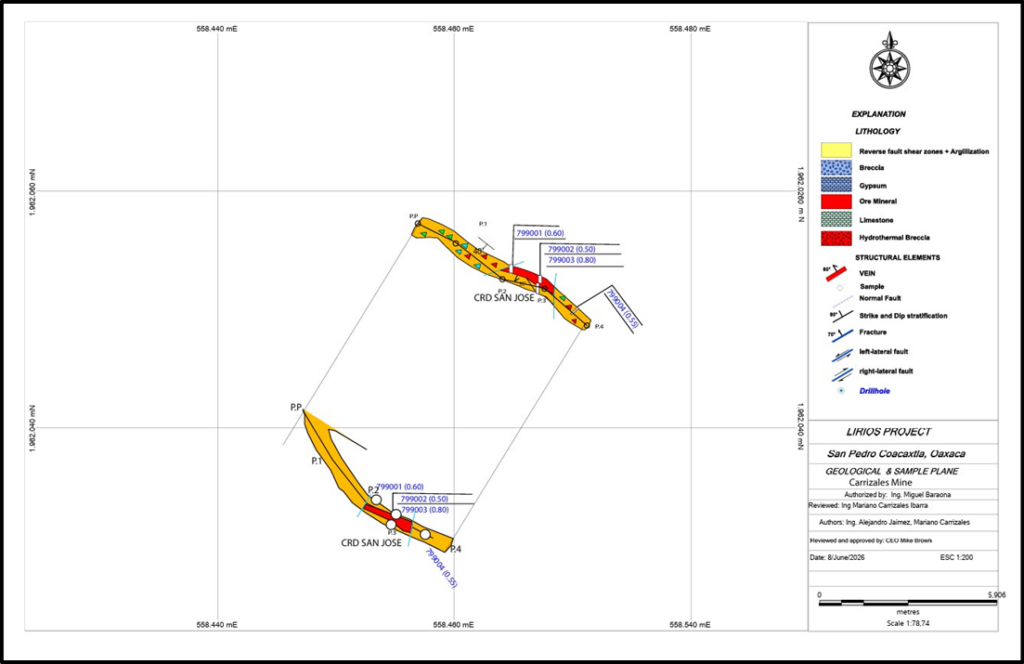
The Carrizales working (See Figure 2) comprises an inclined shaft with approximately 18 m of development. It intersects the San José CRD as a black, porous replacement body with disseminated and vein-hosted stibnite and cervantite, and at approximately 16 m intersects the Carrizales hydrothermal breccia over a width of 0.55 m. Channel samples 799001–799004 were collected across these intervals.
Mapping in the adjacent Carrizales–Santiago area identified mineralised float associated with historical waste dumps adjacent to Geophysical Line 4. Follow-up geological reconnaissance traced this material to the historical Santiago Mine, a near-horizontal working with approximately 13 m of development.
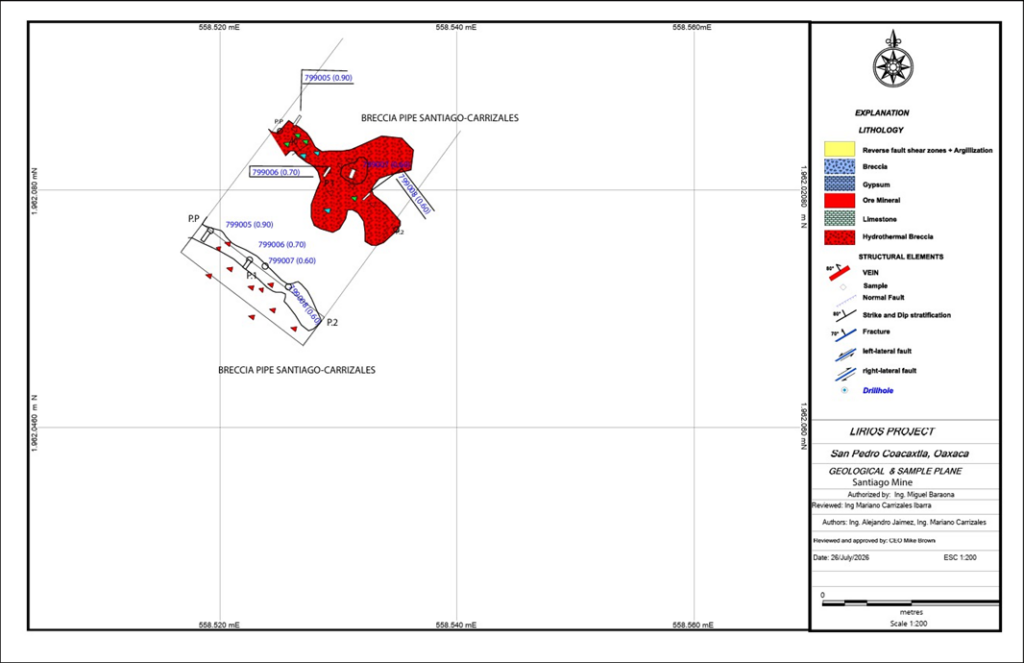
The Santiago working exposes a polymictic hydrothermal breccia of angular black limestone and CRD clasts supported in an intensely argillic-altered matrix, with disseminated cervantite and millimetre-scale veinlets (see Figure 3). Systematic channel samples (799005–799008) were collected to characterise the mineralisation and host lithologies. The coincidence of antimony mineralisation, intense hydrothermal alteration and a previously defined geophysical anomaly is consistent with a hydrothermal breccia pipe, though geometry, size and continuity remain to be confirmed by drilling.
Cofradía–San Manuel Corridor Delivers Strongest Mineral Observations
Mapping and reconnaissance in the Cofradía Target confirmed a hydrothermal breccia system exposed by historic workings at the San Manuel Mine and the Tetlate Shafts, hosted within stratified limestone and gypsum affected by hydrothermal brecciation.
At the San Manuel Mine, approximately 5.5 m of historic development exposes the Cofradía–San Manuel breccia, with millimetre-scale cervantite veinlets filling fractures and interclast porosity (see Figure 4). Sample 799009 was collected from the working to test for cervantite in veinlets.
Four shallow shafts were identified at Tetlate. Tetlate Shaft 1 exposes the Cofradía–San Manuel hydrothermal breccia system and was sampled as 799010. Tetlate Shaft 3 provides a further exposure of the interpreted hydrothermal breccia system. Channel sampling of Tetlate Shaft 3 is planned as part of the next phase of work.
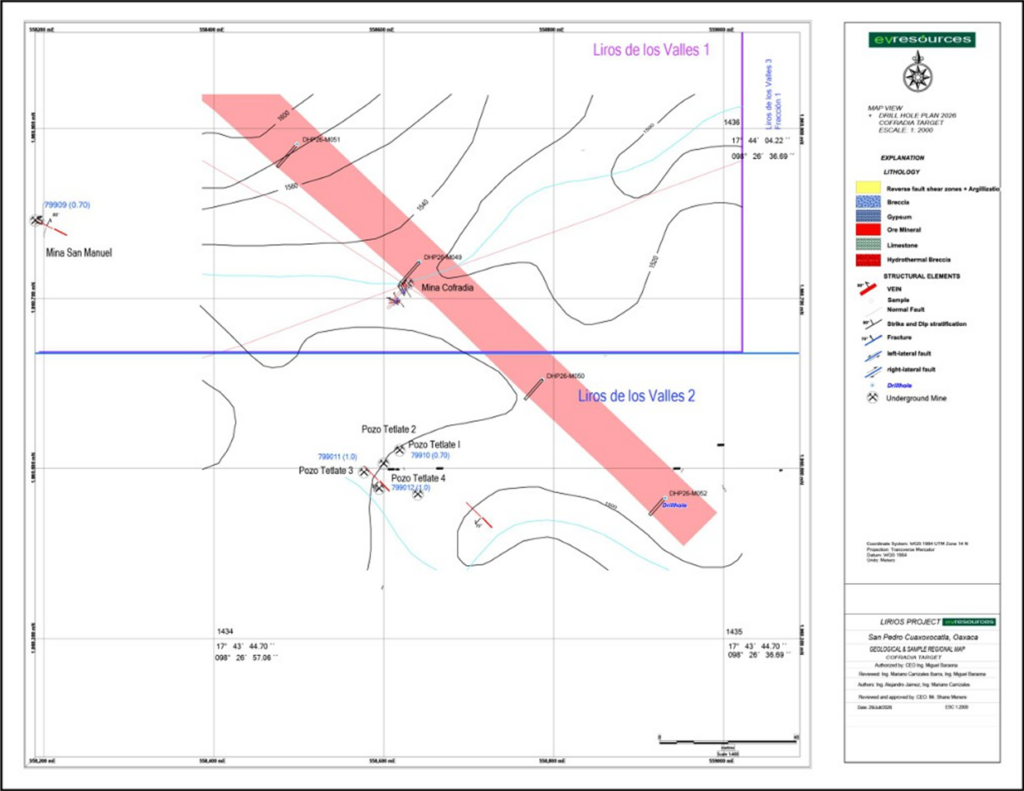
Taken together, the workings expose the same hydrothermal system over a meaningful strike length, with antimony intensity increasing from trace cervantite at San Manuel to abundant visible stibnite at Tetlate Shaft 3.
Sampling Program Submitted for Analysis
All samples collected during the program have been submitted for laboratory analysis (See Table 1 below). Assay results are expected over the coming weeks and will be released to the market once received, verified and interpreted.
Table 1: Below: Summary of Channel Samples Collected for Analysis
| Sample ID | Location | Geological Description (visual) |
|---|---|---|
| 21 channel samples | Los Lirios 1 Open Pit, Pit 6, San Benito Dyke, Crucero JIU, Upper Fold Hinge, Cofradía | Channel sampling across exposed mineralised zones to test geological continuity and mineralisation controls. |
| 799001 | Carrizales underground working | San José CRD — black, porous replacement body with vuggy textures, disseminated and vein-hosted stibnite and cervantite. |
| 799002–799003 | Carrizales, ~13 m along development | San José CRD within hydrothermal fibrous gypsum; stibnite pockets along the gypsum–breccia contact. |
| 799004 | Carrizales, ~16 m along development | Carrizales hydrothermal breccia over 0.55 m; altered matrix with disseminated cervantite and fine cervantite veinlets. |
| 799005–799008 | Santiago underground working | Santiago–Carrizales breccia; angular limestone and CRD clasts in an argillic matrix, disseminated cervantite and veinlets. |
| 799009 | San Manuel Mine | Cofradía–San Manuel breccia; millimetre-scale cervantite veinlets in fractures and interclast porosity. |
| 799010 | Tetlate Shaft 1 | Cofradía–San Manuel hydrothermal breccia system with calcite–cervantite veinlets within fractures and interclast porosity. |
Note: mineral abundances described above are visual field estimates only and are not a substitute for assay results. Visual estimates of stibnite and cervantite abundance should not be relied upon as an indication of antimony grade. All samples are channel samples; widths reported are channel widths, not true widths.
Forward Plan and Next Steps
- Receive and report assay results from the 31 channel samples currently with the laboratory, with results released to the market as received.
- Advance systematic trenching and test pits along the projected extensions of the San Elias and San Miguel structures, and evaluate exploration pits to test the continuity of replacement mineralisation.
- Complete detailed mapping and systematic channel sampling of the San Francisco Breccia Pipe and Santiago targets, including channel sampling of Tetlate Shaft 3.
- Complete ground geophysics across the Cofradía–San Manuel and Santiago–Carrizales corridors to define breccia geometry ahead of drilling.
- Design and commence a phased diamond drilling program targeting the interpreted breccia pipes and the intersections between the Santo Niño, San Ramón and JIU feeder structures and the San José CRD, under the recently confirmed Phase 2 drilling authorisation.
- Integrate all geological, analytical and geophysical data into a 3D geological model to support the targeted maiden JORC Mineral Resource Estimate at Los Lirios.
– ENDS –
This announcement was authorised for release by the Board of EV Resources Ltd.
For further information, please contact:
Shane Menere
Executive Chairman
Tel: +61 8 6489 0600
E: [email protected]
Forward Looking Statement
Forward Looking Statements regarding EVR´s plans with respect to its mineral properties and programs are statements that are not historical facts. Words such as “expect(s)”, “feel(s)”, “believe(s)”, “will”, “may”, “anticipate(s)”, “potential(s)”and similar expressions are intended to identify forward-looking statements. These statements include, but are not limited to statements regarding future production, resources or reserves and exploration results. All of such statements are subject to certain risks and uncertainties, many of which are difficult to predict and generally beyond the control of the company, that could cause actual results to differ materially from those expressed in, or implied or projected by, the forward-looking information and statements. There can be no assurance that EVR’s plans for development of its mineral properties will proceed as currently expected. There can also be no assurance that EVR will be able to confirm the presence of additional mineral resources, that any mineralisation will prove to be economic or that a mine will successfully be developed on any of EVR’s mineral properties. The performance of EVR may be influenced by a number of factors which are outside the control of the Company and its Directors, staff, and contractors.
These risks and uncertainties include, but are not limited to: (i) those relating to the interpretation of drill results, the geology, grade and continuity of mineral deposits and conclusions of economic evaluations, (ii) risks relating to possible variations in reserves, grade, planned mining dilution and ore loss, or recovery rates and changes in project parameters as plans continue to be refined, (iii) the potential for delays in exploration or development activities or the completion of feasibility studies, (iv) risks related to commodity price and foreign exchange rate fluctuations, (v) risks related to failure to obtain adequate financing on a timely basis and on acceptable terms or delays in obtaining governmental approvals or in the completion of development or construction activities, and (vi) other risks and uncertainties related to the company’s prospects, properties and business strategy. Our audience is cautioned not to place undue reliance on these forward-looking statements that speak only as of the date hereof, and we do not undertake any obligation to revise and disseminate forward-looking statements to reflect events or circumstances after the date hereof, or to reflect the occurrence of or non-occurrence of any events.
We are rapidly transitioning from a diversified explorer to an expected near-term antimony producer. Antimony is a designated critical mineral by the US, EU, and Australia, with applications in energy storage, battery technology, defence, and high-tech applications.
About EV Resources
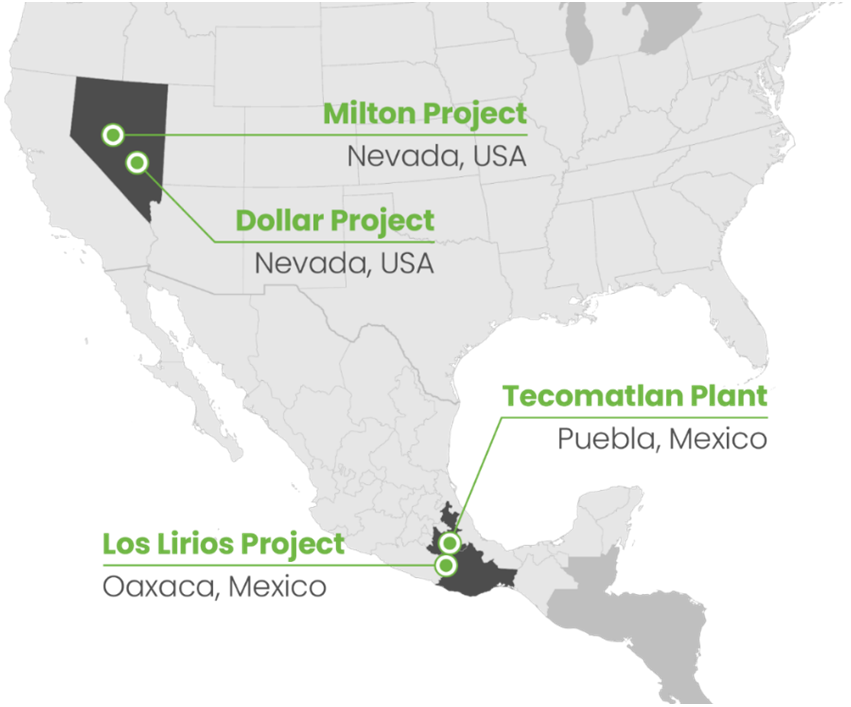
EV Resources (ASX: EVR) is a critical minerals exploration and development company focused on securing the North American antimony supply chain.
Our asset portfolio is strategically positioned in mining-friendly jurisdictions:
Tecomatlán Processing Plant (Mexico): EVR’s regional antimony processing hub and centrepiece of its near-term Proof-of-Concept strategy. EVR is completing plant integration while establishing regional third-party ore supply, targeting the production of a marketable antimony concentrate and demonstrating the Tecomatlán processing model.
Los Lirios Antimony Project (Mexico): EVR’s high-grade antimony project located approximately 50km from Tecomatlán. Work is progressing towards a maiden JORC Mineral Resource, with Los Lirios being advanced in parallel as a potential future proprietary feed source complementing EVR’s regional third-party ore supply.
US Antimony Projects – Dollar and Milton (Nevada): EVR’s 100%-owned US antimony assets provide direct exposure to the US critical minerals supply chain and complement the Company’s Mexican processing and feedstock strategy as it builds an integrated North American antimony platform.
Integrated North American Antimony Strategy
EVR is building an integrated North American antimony value chain, combining regional ore supply and processing at Tecomatlán, potential future proprietary feed from Los Lirios and direct US exposure through its Nevada assets.
EVR is funded through its planned Proof-of-Concept phase and is targeting production of a marketable antimony concentrate. Beyond Proof-of-Concept, the Company intends to pursue select strategic and offtake partnerships to accelerate its objective of supplying antimony into the North American market.
Appendix 1 – Sampling Location and Geological Map Figures
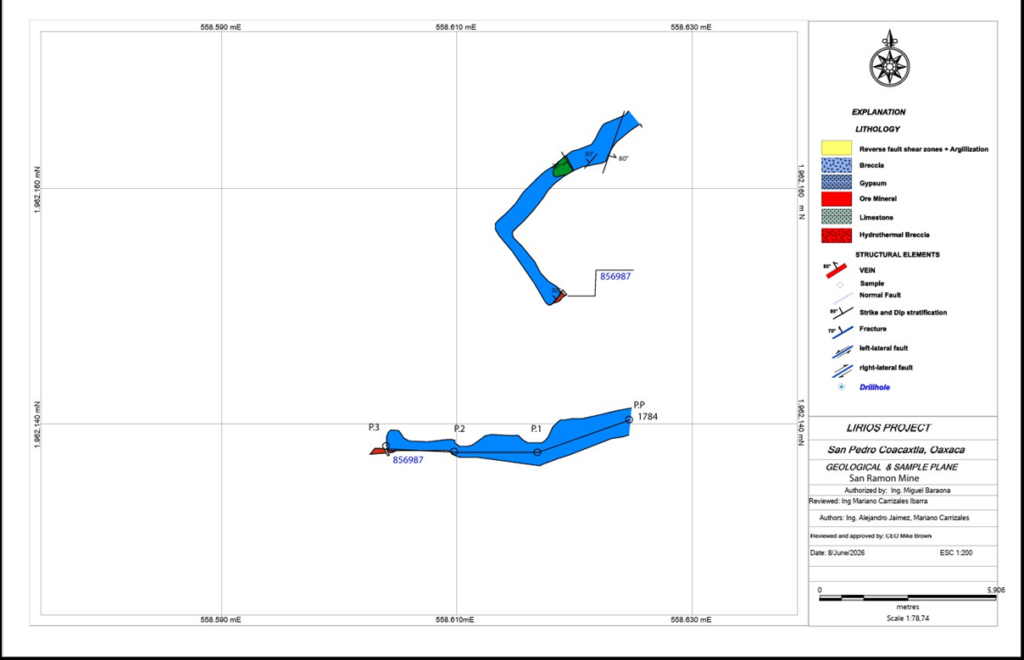
Source: EV Resources Ltd.
Original Press Release: https://api.investi.com.au/api/announcements/evr/e72cddfb-67a.pdf